What Is a Tiltmeter? How It Works, Types, and Applications in SHM
Join the Move Solutions newsletter
Stay updated on product releases, news, and upcoming webinars.
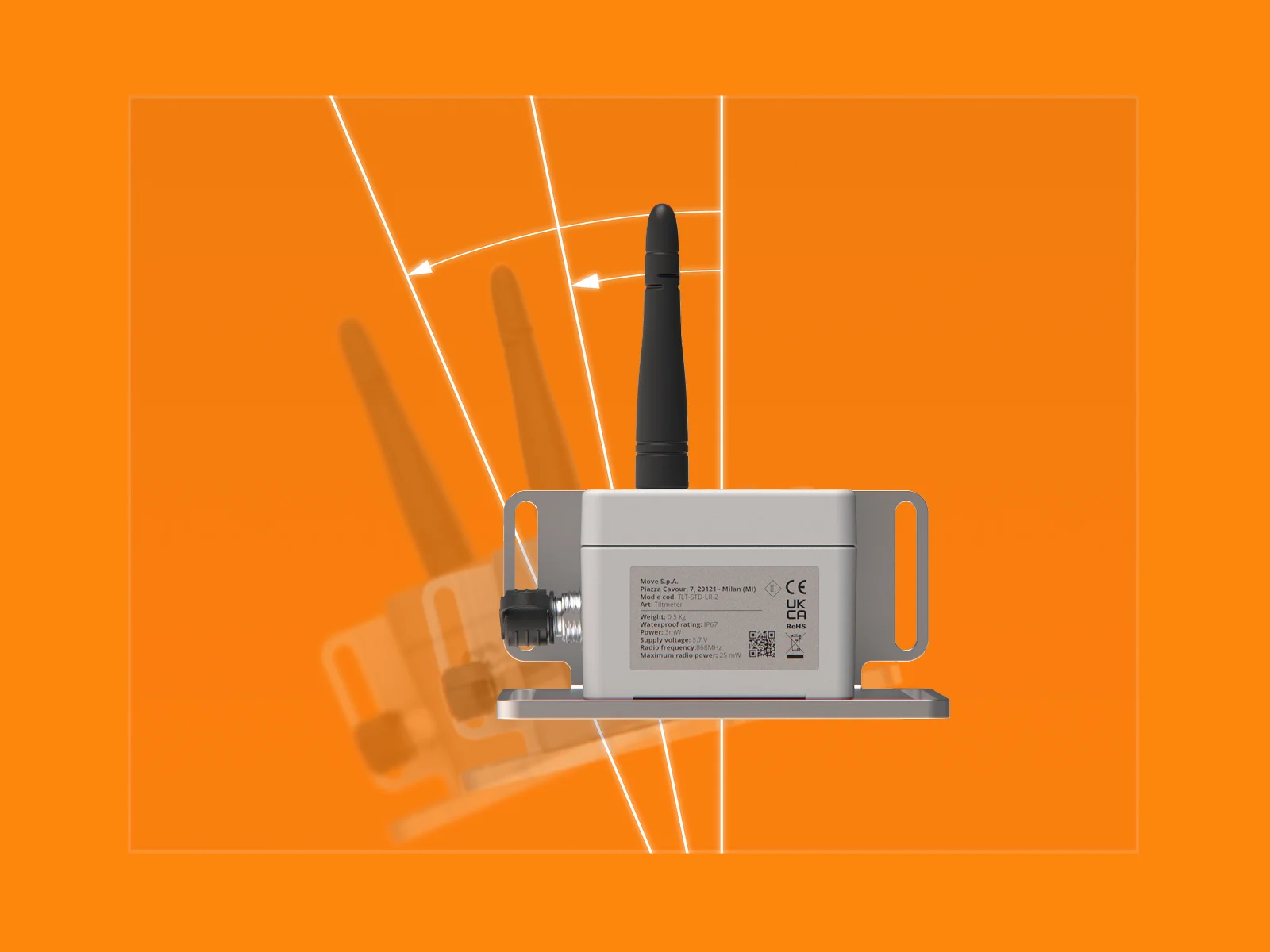
A tiltmeter is a sensor that returns an angle. Everything else, from displacements to deformation profiles to alarms, is calculated from that angle, usually by multiplying it by a geometric lever arm between the sensor and the point of interest.
Although the concept is simple, this data can be used in many ways for the structural monitoring of buildings, bridges, construction sites or dams.
What a tiltmeter measures
The native measurement is the rotation around one or two orthogonal axes, expressed in degrees, microradians or millidegrees. MEMS tiltmeters available on the market today routinely resolve 0.001°, which corresponds to approximately 17 microradians. Precision electrolytic sensors reach 0.0005°.
When an inclinometry report states a "top displacement of 0.17 mm," that value is calculated, not directly measured. You take the measured angle (0.001°), multiply it by the vertical distance between the sensor and the point of interest (a 10-meter lever arm), and you get the equivalent horizontal displacement at the top of the element.
The practical consequence is that the effective sensitivity of a tiltmeter depends on the geometry of the structure just as much as on the sensor itself. The same instrument, placed on a 2-meter pier and on a 20-meter pier, produces very different sensitivities at the top: sub-millimetric in the second case, sub-tenth of a millimeter in the first. On paper, the 0.001° is identical, but in the field the differences are clearly visible.
The four technology families
Commercially available tiltmeters fall into four families.
MEMS
Micro-electro-mechanical systems: in practice, a silicon mass suspended on a capacitive system. They are compact, low-power, vibration-tolerant, factory temperature-compensated, with a current resolution of 0.001°. They are the standard for civil structural monitoring, where they cover the vast majority of deployments.
Electrolytic
These tiltmeters use a conductive fluid enclosed between electrodes: when the tilt changes, the conductivity changes and the signal adjusts accordingly. Declared resolutions reach up to 0.0005° in laboratory conditions. The downside is that they are sensitive to thermal and mechanical shocks, and therefore require more care during installation.
Force-balance
In this type of sensor, a pendulum is held in position by an active feedback loop. Resolutions are in the nanorad range, which makes them suitable for tectonic and geophysical monitoring. They are expensive instruments and decidedly out of scale for standard structural monitoring.
Vibrating-wire
The principle is a tensioned wire whose resonant frequency changes with tilt. They are robust in harsh environments and compatible with traditional geotechnical data loggers, although sampling is slower compared to MEMS.
In practice, for bridges, buildings, tunnels and slopes, MEMS covers nearly all new projects. The electrolytic survives in installations where extreme precision is required. The force-balance belongs to the world of seismology and research. The vibrating-wire is used where the acquisition infrastructure is already vibrating-wire.
Why wireless changed the economics of monitoring
Until the mid-2010s, installing a tiltmeter meant first of all planning the cabling. Cable tray routes, junction boxes, central data logger, stabilized power supply, sometimes a UPS. On a medium-span viaduct, two to three weeks of civil works were the norm. And the cost of the sensors was only a fraction of the total system cost, typically 20-30%. Everything else went into supporting infrastructure.
The wireless tiltmeter flipped this proportion. A sensor powered by a 19 Ah LiSOCl₂ battery communicates via LoRaWAN, proprietary LoRa mesh or cellular LPWAN for kilometers in open field, lasts years without intervention and is installed with four bolts or a structural bonding. The data logger becomes a single gateway positioned where coverage exists. External power disappears and the timelines for the civil works needed to install the system collapse.
This way, a monitoring program that previously required 2-3 weeks of site work is now installed in a single day. On a 300-meter viaduct with eight piers, a two-person crew places the sensors, verifies the connection to the gateway, registers the sensors on the platform and delivers the first data by evening. Anyone who has already designed a wired system immediately recognizes the difference in the quote.
Naturally, wireless introduces variables that wired systems did not have. Radio link quality, battery life as a function of sampling rate, firmware management in the field. An aggressive sampling at 3.9 Hz in event mode consumes battery much more rapidly than static sampling at 1 sample every 10 minutes. The campaign dimensioning must account for this trade-off already at the design stage, before the sensors are placed.
Where tiltmeters find their place
Tiltmeters appear in nearly every infrastructure monitoring portfolio because they answer a very specific question: "is this element rotating?" The main application areas are six.
Bridges and viaducts
Used to monitor pier rotation, bearing tilting, deck torsion and arch springing rotation under load. On bridges classified as High Attention under the CSLP Bridge Guidelines, the tiltmeter is often the first permanent sensor installed: it can detect the slow evolution of a foundation settlement before visible damage makes its appearance.
Buildings and above-ground structures
Helps measure column verticality during adjacent construction, differential settlements and residual post-earthquake drift. If tiltmeters are placed on different floors, they form a chain that allows the reconstruction of the deformation profile in height.
Dams
Monitors the upstream face rotation as the reservoir level varies, the slow creep of rock abutments and the movement of overflow sills.
Tunnels and underground works
Here the tiltmeter is used for: lining convergence, settlement of buildings above during TBM advance, rotation of portal structures.
Landslides and slopes
Used to monitor surface rotation as a precursor to shallow collapse and in-hole chains to reconstruct subsurface deformation as a function of depth.
Heritage structures
Used to measure the tilt of bell towers, historic facades, statues, monuments and all cases where non-invasive mounting and removability are non-negotiable design constraints.
In essence, the tiltmeter recurs across all categories of monitored civil works, from the concrete dam to the sixteenth-century bell tower.
From a single point to the deformation profile
A single tiltmeter returns the angular state of one point. But on a deep excavation retaining wall, on a facade in differential rotation, in a vertical borehole crossing a moving slope, we do not want to know whether a point is rotating but rather we want to understand what the shape of the deformation is along the entire height or depth.
And so the chain is used. You take multiple tiltmeters and arrange them in a known geometry (vertical in an inclinometer casing, horizontal along a beam, distributed across the floors of a building), each of which measures its own local angle. By integrating the angles segment by segment, software reconstructs the cumulative displacement along the chain. The result is a deformation profile that evolves over time.
Move Solutions has developed the Tiltmeter Chain Tool, a module of the MyMove platform that converts raw angular data from a sensor chain into cumulative displacement profiles, segment-by-segment differential analysis and time evolution. The underlying logic is the same that manual in-hole tiltmeters have applied for decades: discretize the structure into elements, assign to each element the angle of its associated sensor, sum the displacements. What changes is that the reading happens continuously and remotely, instead of once a month with an operator in the field.
How to read a datasheet without being misled
Three terms appear on every tiltmeter datasheet and can be confusing: resolution, repeatability, accuracy.
Resolution is the smallest change the sensor can distinguish. If the resolution is 0.001°, it means the sensor sees the difference between 10.000° and 10.001°.
Repeatability is how reliably the sensor returns the same reading under the same conditions. If you place the sensor on a fixed reference and repeat the reading one hundred times at constant temperature, the standard deviation of those hundred readings gives you the repeatability.
Accuracy is how close the reading is to the true value. A tiltmeter can have excellent resolution (0.001°) and mediocre accuracy (the absolute zero offset by 0.01° from the true value). For structural monitoring, in most cases, repeatability matters more than accuracy: what matters is the variation from the baseline, not the absolute value.
And this is a non-obvious point. Sensors chosen by chasing the lowest resolution but with mediocre repeatability end up oscillating more than the signal they are supposed to capture. A serious specification asks for repeatability declared under real operating conditions (temperature range, integration time, bandwidth), not just resolution measured on the bench.
There are two more elements to read carefully.
Temperature compensation. Every tiltmeter, even a factory-compensated MEMS, shows a residual thermal drift. On a sun-exposed pier, the diurnal cycle produces oscillations of a few thousandths of a degree that resemble real movement. This is why the processing pipeline must include a thermal correction, which can be empirical or based on the sensor's internal temperature channel.
Baseline and operational zero. The "zero" of an installed tiltmeter does not coincide with the factory value. It is the average of the first N readings after installation on the real structure, once the sensor has settled thermally and mechanically. All subsequent variations must be referred to that baseline.
What a tiltmeter does not do
A tiltmeter does not measure:
- Direct linear displacement. Displacement is always inferred from the angle multiplied by a lever arm. If the lever arm is not known with precision, the displacement is not either.
- Vibrations and modal frequencies. That is the domain of the accelerometer. A tiltmeter samples too slowly and its dynamic response is dominated by the gravitational effect, not by the structural acceleration.
- Material deformation (strain). For that, resistance strain gauges or fiber optic sensors are needed.
- Absolute position in space. A tiltmeter does not know where it is. For absolute position, GNSS or robotic total stations are needed.
- Vertical settlement in rigid rotation. If an element translates vertically without rotating, the tiltmeter sees nothing. And the same applies if the entire structure rotates as a rigid body: the tiltmeter measures the rotation, but it does not tell us whether the base has settled.
The tiltmeter, in short, is part of a broader monitoring portfolio. In a complete campaign it coexists with accelerometers (for dynamics and seismic response), vibrometers (for external vibration sources), dynamic displacement sensors, environmental sensors (temperature, humidity, wind). The right choice is almost always a well-calibrated subset, not a single instrument.
A terminological note. In Italian, "inclinometro" covers both the fixed or wireless sensor permanently installed on the structure (which is the subject of this guide) and the manual in-hole instrument (tiltmeter casing plus probe) used in geotechnical campaigns. They are two devices with different architectures and use cases, even though they share the name.
The next releases of MEMS tiltmeters under development are working along three parallel directions: extending battery life beyond the decade in slow sampling mode, native integration of the temperature channel in the compensation model, broadband noise reduction to push operational repeatability closer to datasheet resolution. It is in this space that the next generation of structural monitoring campaigns will be decided.
Other articles





Subscribe to Updates
Stay informed about our latest innovations and insights.