What Is a Vibrometer? Types, Applications, and How to Choose One
Join the Move Solutions newsletter
Stay updated on product releases, news, and upcoming webinars.
Most engineers searching "what is a vibrometer" in 2026 are not curious. They are procurement. A regulator has handed them a deadline, an asset owner has handed them a budget, and now they need to know which device on the market actually does what their consultant wrote in the spec. The instrument itself is older than IoT, older than MEMS, older than most of the people responsible for choosing one. What has changed completely in the last five years is how it is deployed. This guide covers the device, the families that exist, where each one fits, and the criteria that matter when you put a real project out to tender.
What a vibrometer is, in one paragraph
A vibrometer is a measurement device that quantifies the mechanical vibration of a surface by sampling its displacement, velocity, or acceleration in time. The output is a time-series, usually expressed in mm/s RMS for civil applications or in g for industrial ones, that lets you analyse the signal in the time or frequency domain and extract amplitude, natural frequencies, mode shapes and damping. The label is broad. It covers a six-figure scanning Laser Doppler system from Polytec and it covers a wireless node that sits on a viaduct for five years on a single battery. Both are vibrometers in the dictionary sense, and the conversation about which one you actually need is where most procurement starts.
The terminology in this market is fuzzy on purpose, and three distinctions are worth fixing before going further:
- A vibration sensor is the generic term for any device that detects motion.
- A vibration meter is usually a handheld field instrument that shows a single severity value, used for spot-checks.
- A vibrometer is the more specific category designed to produce calibrated vibration data for engineering analysis, anything from high-end laser systems to wireless monitoring nodes.
Vibrometer vs accelerometer, the question that won't die
This is the question Move's pre-sales team gets every week. The short answer is that they are complementary tools that often live in the same network.
An accelerometer is optimised for capturing acceleration with high resolution across a wide band. In structural monitoring it is the device of choice for modal analysis, used to resolve the low-amplitude accelerations that reveal a structure's natural frequencies, mode shapes and damping. Move's DECKAXE-SHM is built for exactly this job.
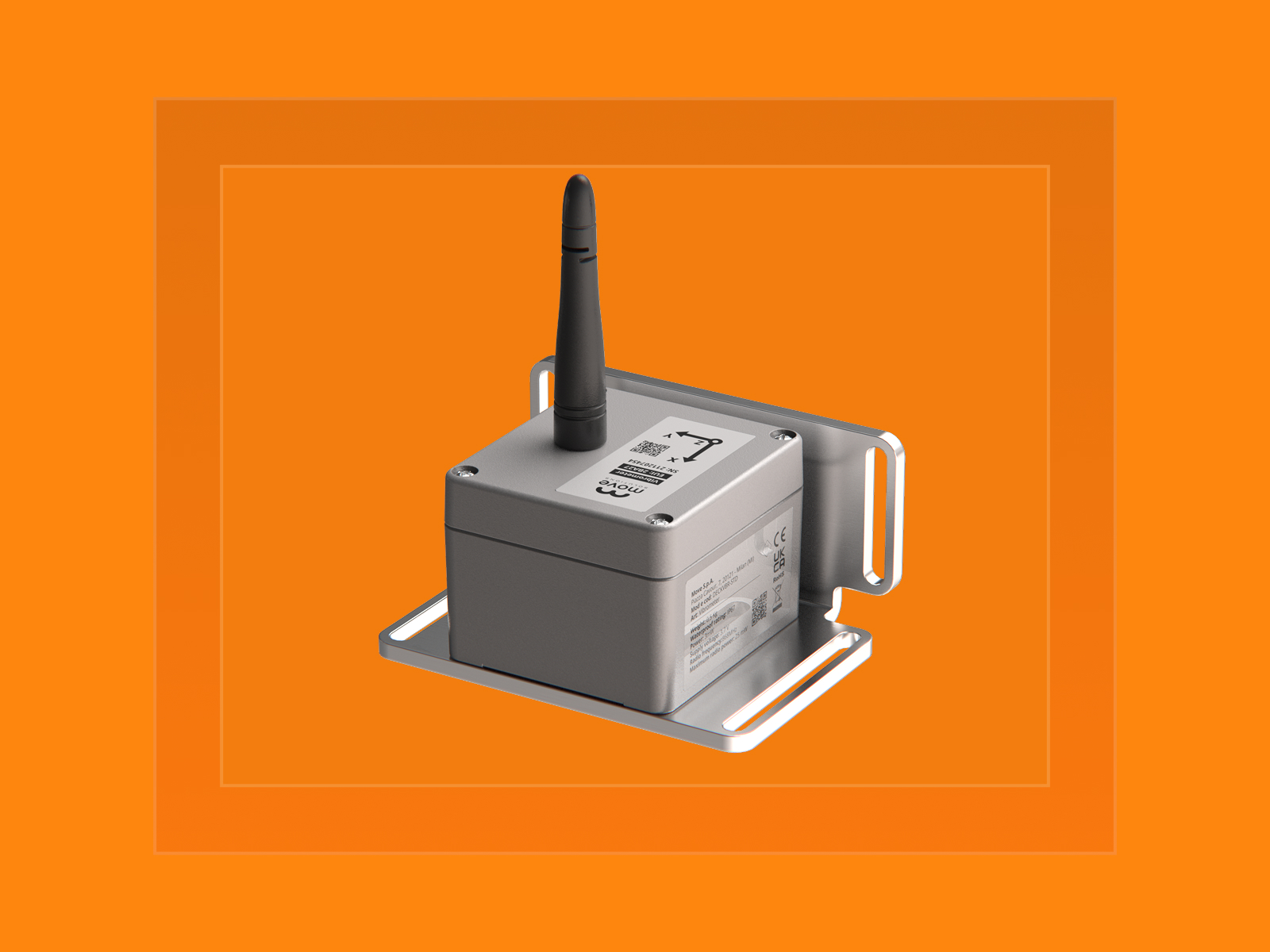
A vibrometer in our market is optimised for measuring vibration as a regulated quantity. In civil engineering this usually means assessing the impact of vibrations on buildings from construction sites, traffic, blasting or piling, compared against the thresholds in DIN 4150-3 and UNI 9916. Move's DECKVBR-STD is built specifically for that use case.
In practice the two devices coexist on the same job. The accelerometer answers "how does this structure behave dynamically?". The vibrometer answers "are the vibrations we are imposing on it acceptable?". On most construction-near-existing-asset projects you need both questions answered.
How a vibrometer works
The principle is mechanical-to-electrical conversion. You turn the motion of a surface into a measurable signal proportional to that motion. From there the signal goes through conditioning, sampling, and analysis. The split that matters operationally is whether the conversion happens by touching the surface or by bouncing light off it.
Contact-based, piezoelectric and MEMS
A contact vibrometer sits on the surface being measured. The original transducer is a piezoelectric element, a crystal that produces an electric charge proportional to acceleration when strained by a small internal mass. Piezo is rugged, has very wide bandwidth, and was the industrial default for fifty years.
MEMS came later. The silicon-machined version is miniaturised, low-power, and over the last decade has closed the performance gap with piezo in the low-frequency band that civil engineering cares about. That gap is now narrow enough that for any application below about 200 Hz, MEMS is the obvious choice. Above that range, in high-RPM turbomachinery, ultrasonic NDT, or MEMS resonator R&D, piezo and LDV still win.
Non-contact, laser Doppler vibrometry
A Laser Doppler Vibrometer (LDV) measures vibration without touching the target. It works like this:
- A laser beam is pointed at the vibrating surface.
- As the surface moves toward or away from the instrument, the reflected light shifts in frequency, which is the classic Doppler effect.
- The reflected beam is recombined with a reference beam on a photodetector.
- A demodulator extracts the frequency shift and converts it into a voltage proportional to surface velocity.
- Displacement and acceleration are computed by integration or differentiation.
LDV is the gold standard when you need ultra-high resolution, when you cannot mount anything on the surface (hot components, lightweight membranes, or museum artefacts), or when the target moves too fast for contact sensors. It is also genuinely expensive, requires a skilled operator, and is fundamentally an offline campaign tool. We say this often to clients who arrive convinced that they need an LDV for continuous bridge monitoring. They almost never do.
Types of vibrometers
There is no single "best" vibrometer. There are categories, each built for a class of problems.
Piezoelectric
The industrial workhorse. Rugged enclosures, wide bandwidth (a few Hz to tens of kHz), two electronic variants. The older charge-mode needs external amplification, while modern voltage-mode (IEPE) integrates the amplifier into the sensor. Best fit, rotating machinery, condition monitoring, high-frequency phenomena.
MEMS
The technology that made permanent SHM economically feasible. A modern MEMS device offers sub-milli-g resolution, very low power consumption, and runs for years on a single battery. These are the characteristics that make MEMS the natural choice for distributed wireless networks on civil structures, where you can put thirty nodes on a viaduct without cabling any of them.
Move's wireless line is built on this generation. The DECKVBR-STD handles environmental vibration impact (DIN 4150-3, UNI 9916, BS 7385), the DECKAXE-SHM handles modal analysis on bridges and large structures, and the DECKINC tiltmeter handles rotation. They all share the same MyMove cloud back-end, which is the part that actually matters for asset owners managing dozens of sites.
Laser Doppler Vibrometers
LDV is a family of optical, non-contact instruments with four important sub-types:
- Single-point LDV measures one well-defined point with extreme precision. Standard tool for component-level modal analysis or contactless spot checks.
- Scanning LDV automates the beam across a grid of points and produces full-field mode shape maps. The standard tool in R&D, automotive NVH and aerospace structural dynamics.
- 3D LDV uses three beams from different angles to capture motion in all three directions simultaneously, including in-plane components that monoaxial instruments miss.
- Differential LDV measures the relative motion between two points, useful when relative displacement matters more than absolute motion.
Heterodyne vs homodyne
Homodyne uses one laser frequency and detects motion through phase shifts. Heterodyne adds a known frequency offset (usually a Bragg cell, around 40 MHz) so the demodulator can resolve very small displacements and tell the direction of motion. Almost every commercial LDV is heterodyne.
Handheld vibration meters
The simple end of the spectrum is a portable probe used by maintenance technicians for spot readings on motors, pumps and gearboxes. These devices are cheap, fast, and good enough for many predictive-maintenance workflows. They are not designed for the precision or the continuous coverage that an SHM campaign requires.
What people actually use vibrometers for
Industrial machinery and predictive maintenance
The original application. Rotating equipment (pumps, compressors, motors, gearboxes, fans, and conveyors) generates a vibration signature that changes when bearings wear, when shafts misalign, when blades unbalance, or when something works loose. Piezo or MEMS sensors paired with handheld meters or permanent systems are the standard. Catching a bearing fault months before failure routinely saves tens of thousands of euros in unplanned downtime. That economics is what carried the whole vibration-monitoring industry for thirty years.
Automotive and aerospace
NVH testing leans heavily on Laser Doppler Vibrometry. The non-contact method does not mass-load the lightweight panels, brake systems and rotating parts being measured. Scanning LDV is the workhorse for mapping the modal behaviour of fuselage panels, engine casings and brake discs during development.
Energy generation
Turbines, generators, transformers and wind-turbine drivetrains run continuously instrumented. The frequency content spans rotational lows to gear-mesh highs, and the cost of an unplanned failure on a 5 MW turbine justifies whatever you spend on permanent instrumentation.
Electronics and MEMS testing
In R&D and QC, single-point and 3D LDV systems characterise hard-disk heads, MEMS resonators, loudspeakers and ultrasonic transducers, anywhere contact would corrupt the measurement.
Civil engineering and SHM
This is the application Move is built around, and the one where the choice of vibrometer has the most economic consequence over a 20-year horizon. Civil structures vibrate at very low frequencies, typically below 10 Hz, with first modes of long bridges often below 1 Hz and many short- to medium-span bridges in the 2 to 5 Hz range. Capturing that signal needs sensors with excellent low-frequency response and a very low noise floor. The applications fall into three buckets:
- Modal analysis to identify the first natural frequencies, mode shapes and damping of new or existing structures.
- Vibration impact assessment during nearby construction, demolition, blasting or piling, measured against DIN 4150-3 and UNI 9916 thresholds.
- Long-term structural health monitoring to track how a structure's dynamic signature evolves over years and to flag the drift that signals stiffness loss.
We expand on this in the SHM section below. It is the part of the article most readers came for.
Research and academia
Universities are heavy LDV users, both for modal testing benches and for biomechanics, acoustics and materials characterisation labs. The non-contact precision is what they pay for.
How to choose a vibrometer
Before comparing brands, work through five questions. They are the same ones Move's sales team asks during scoping.
1. What are you measuring?
The structure or asset, the expected frequency content, and the amplitude you want to capture. A 3,600 RPM electric motor and a 150-metre cable-stayed bridge produce vibrations at completely different scales and need completely different instruments.
2. What frequency range?
Match the instrument's bandwidth to the physics. For civil structures, 0.1 to 100 Hz is more than enough. For machinery condition monitoring, you need tens of kHz. For MEMS or ultrasonic research, hundreds of kHz up to MHz.
3. Contact or non-contact?
Contact (piezo, MEMS) is cheaper, easier to deploy, and the natural choice for continuous monitoring. Non-contact LDV is the right answer when the surface is hot, fragile, lightweight, hard to reach, or when adding mass would change the measurement.
4. Single point, scanning, or 3D?
A single number per location calls for single-point. For the mode shape across a full surface you need scanning or a network of sensors. If in-plane motion matters, you need 3D.
5. One campaign or continuous monitoring?
A one-off measurement campaign means a portable LDV or a handful of wired sensors will do. Monitoring a structure for months or years means a system designed for permanent deployment, with wireless connectivity, multi-year battery life, IP-rated enclosures, automatic cloud sync, and alarming. This is what modern wireless SHM networks are for, and it is what the MIT 2020 guidelines in Italy now effectively require for at-risk bridges.
A checklist for the supplier conversation
When you talk to a vendor, ask about:
- Frequency range, dynamic range, and noise floor (don't accept "wide" as an answer).
- Number of axes (single, biaxial, triaxial).
- IP rating (IP65 or better for outdoor installs).
- Battery life on your real duty cycle, not the data-sheet best case.
- Sampling rate and onboard processing.
- Compliance with the relevant standards (ISO 2954 for severity, ISO 16063-1 for calibration, DIN 4150-3 and UNI 9916 for vibration impact on buildings, BS 7385 if you operate in the UK).
- Calibration certificate included, and the re-calibration cadence the manufacturer recommends.
- Cloud platform, API, and integration with whatever data stack you already have.
- Warranty length and on-site support availability.
Vibrometers in Structural Health Monitoring
For civil and structural engineers, SHM is the application that drives almost all serious vibrometer procurement in 2026. The discipline is simple to describe and difficult to execute. You continuously observe a structure's behaviour and use that data to support maintenance, safety and end-of-life decisions.
Why vibration is the right signal
A structure's natural frequencies and mode shapes are its dynamic fingerprint. They are set by mass, stiffness and boundary conditions. When something damages the structure (a crack opening, a bearing degrading, a foundation settling, or a cable losing tension) stiffness changes and that fingerprint shifts with it. A continuous monitoring network catches the shift long before it produces a visible defect, sometimes years before.
This is the technical reason the MIT 2020 guidelines in Italy, alongside NTC 2018, now require infrastructure managers to move toward instrumented monitoring on existing bridges and viaducts. Most asset owners we work with hit the same wall the first time they implement this. The regulation tells you to monitor; it does not tell you which signals to capture or how often. At Move our position is that for the vast majority of existing bridges, a sparse permanent accelerometer network plus a vibrometer for any vibration-impact-sensitive site is the right starting point. Adding more sensors comes later, after the baseline data tells you where the structure is talking loudest.
Operational modal analysis, the technique that does the heavy lifting
Civil structures are difficult and expensive to excite artificially. Eccentric mass shakers exist for full-scale bridges, but the cost and traffic disruption make them impractical except for one-off commissioning tests. So engineers fall back on Operational Modal Analysis (OMA), which extracts modal parameters from the structure's ambient response to traffic, wind and micro-tremors. OMA needs sensors with very low noise floor at low frequencies, which is exactly what MEMS accelerometers and wireless vibrometers provide today.
From offline LDV campaigns to continuous wireless networks
Twenty years ago, the standard way to do modal analysis on a bridge was to bring an LDV system on site, run a campaign for a few days, and write a report. The output was useful, but it was a snapshot.
The dominant approach today is a permanent wireless network of accelerometers and vibrometers along the structure. Data streams into a cloud platform (for Move installations, that is MyMove), modal parameters are recomputed automatically, and alarms fire when the dynamic signature drifts. That is what we do on installations like Chetwynd Bridge in the UK and the Zambeccari Bridge in Italy.
The two approaches are not exclusive. A high-resolution LDV campaign still beats anything wireless for picometre-level baseline characterisation. The wireless network is what tells you what is happening between campaigns, every day, for years. We disagree with most of the industry on the framing here. Consultants still treat LDV campaigns as the "real" measurement and continuous sensors as a complement. We invert that. The continuous network is the real measurement, because it captures the structure under the loads it actually experiences. The LDV campaign is the auxiliary tool, useful when the network flags something specific that deserves a closer look.
Bridges, buildings and heritage sites
- Bridges and viaducts. Engineers track natural frequencies and damping continuously, watch for cable-tension loss on cable-stayed structures, run integrity checks after seismic events or impacts, and document compliance with national monitoring guidelines.
- Buildings. Engineers run modal characterisation at the commissioning of newly built tall structures, and they monitor vibration impact during nearby construction or excavation work.
- Heritage sites. When a project involves historical buildings, monuments or archaeological structures, anything that requires drilling or cabling is off the table. Wireless MEMS sensors install with minimal intrusion and remove without trace, which is why they show up on jobs like the ongoing monitoring work in Odesa.
Frequently Asked Questions
When does Move recommend AGAINST continuous monitoring?
When the structure has no regulatory monitoring obligation, no active deterioration, no nearby work that could induce vibrations, and a solid visual-inspection regime that is actually being followed. Continuous monitoring is not free, and on a stable concrete viaduct in the middle of nowhere with biennial inspection it adds cost without changing decisions. Asset owners do not always like hearing this from a sensor vendor.
What is the single biggest mistake in first-time SHM deployments?
Putting too many sensors in the wrong places. New programs tend to instrument everything they can reach, get drowned in data they cannot interpret, and lose credibility with the asset owner within 18 months. The fix runs opposite to intuition. Start sparse, place sensors where the structural engineer expects the dominant modes, and expand based on what the data tells you.
Can a vibrometer or accelerometer network replace visual inspection?
No, and anyone selling it that way is overpromising. Sensors catch the things inspectors miss (slow drift in modal frequencies, transient overloads at 3 a.m.). Inspectors catch the things sensors miss (corrosion in a hidden joint, a fastener someone removed). The two are complementary, and the regulatory frameworks in Italy and elsewhere are starting to codify them that way.
Is there a case where LDV still beats a wireless network on a bridge?
Yes, when you need picometre-level resolution on a specific mode shape during a one-off commissioning or post-event campaign. The LDV will resolve detail a MEMS sensor cannot reach. For that single measurement campaign it wins. For the 20 years of operational monitoring around it, it does not.
How many sensors do I actually need on a bridge?
For an existing medium-span bridge, our typical first deployment is 4 to 8 triaxial accelerometers placed at deck mid-span and quarter-spans, plus one tiltmeter on each pier. That is enough to extract the first 3 to 5 modes and to detect significant stiffness changes. We have seen owners specify 30+ sensors in their tender, and in most cases that money would be better spent on a smaller network plus a proper data-analysis subscription.
What does Move not sell that someone else does better?
We do not sell scanning Laser Doppler Vibrometers. If your project requires full-field mode shape mapping at picometre resolution on a stationary component, Polytec or Optomet are the right vendors. Our line is built for permanent wireless deployment on infrastructure, which is the problem we are good at, and it is not the same problem.
Where to go from here
The hardware decision is not as critical as the procurement market makes it sound. What compounds over 20 years of monitoring is the architecture itself. That means wired or wireless, single campaign or permanent network, who owns the data, and how alarms get wired into your maintenance workflow. Pick a sensor that fits the architecture, not an architecture that fits the sensor. If you want to walk through what that looks like for a specific bridge, building or heritage site, book a 30-minute call with our team and bring the project brief.
Other articles

Subscribe to Updates
Stay informed about our latest innovations and insights.