Tunnel Structural Monitoring Without Cables
Join the Move Solutions newsletter
Stay updated on product releases, news, and upcoming webinars.
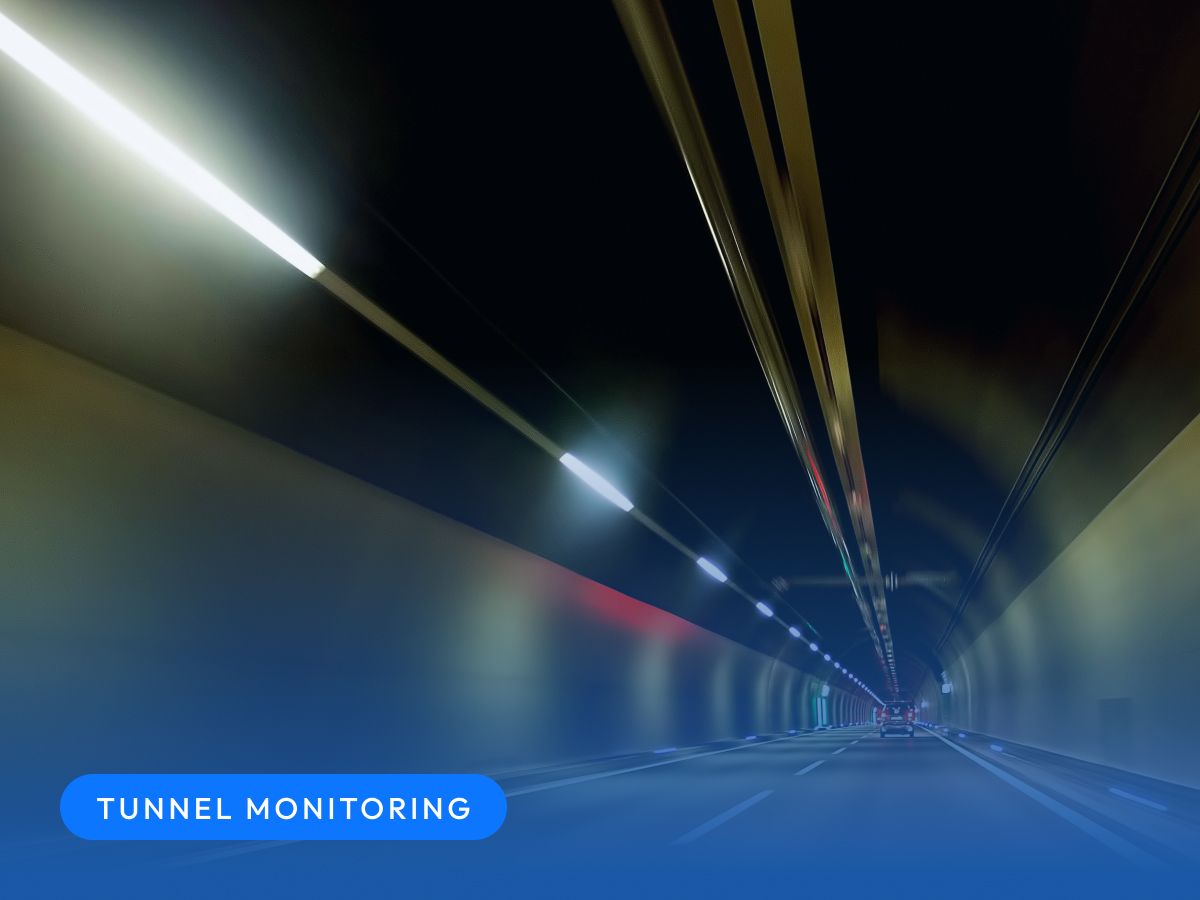
The newest wireless sensors allow for quick deployments of tunnel structural monitoring without the need of limiting traffic or closing a tunnel for days. This new approach to monitoring without cables limits interventions and costs for infrastructure maintainers.
Accessing tunnels
Wiring a tunnel is costly and time consuming. It requires a night possession which needs to be negotiated with the operator weeks in advance to allow enough time for the sensors to be installed and then a long wire to be laid. Such installation involves the whole length of a tunnel and extensive interventions.
A wireless network, with the same coverage, can be installed in a couple of hours with only limited traffic reductions, because no wire needs to be laid down. Each sensor comes with a battery that allows for years of operation, and this can even be extended with an additional battery pack attached to the sensor.
What needs to be monitored in a tunnel
Convergence
Convergence is the progressive reduction of the cross-section as the surrounding ground loads the lining. During excavation, most of the deformation develops in a narrow window around the face, from roughly one tunnel diameter ahead of it to about 1.5 diameters behind it. In operating tunnels the phenomenon is slower, driven by creep in squeezing ground, changes in the groundwater regime, and deterioration of the lining itself.
Lining rotation
Tunnel walls rotate and converge. A sidewall rotating toward the bore while the crown settles indicates a different mechanism than uniform radial convergence. Rotation of segmental linings also concentrates at the joints, where the ring no longer behaves as a monolith.
Movement from adjacent excavations
Construction near an existing tunnel unloads the ground around it, and the existing tunnel can start to settle, drift horizontally or ovalize. During excavations, a tunnel has to be monitored continuously for the whole duration of the works, because a weekly optical survey misses how the tunnel is responding to the excavation sequence.
Tiltmeter chains
Tiltmeters installed in a line along the tunnel axis, each measuring the local inclination of the lining, integrate into a displacement profile in millimeters for the whole instrumented length, using the known spacing between nodes.
A longitudinal settlement profile shows where the trough from an adjacent excavation is centered and how steep its gradients are, while a transversal chain around the ring resolves ovalization. These numbers can then be compared with the code limits. Our Tiltmeter Chains Tool in MyMove computes the profiles from the raw tilt angles, so the conversion from milliradians to millimeters does not live in a spreadsheet that one engineer maintains.
Radio coverage underground
The first objection to wireless monitoring in a tunnel could be the radio link. But a tunnel bore acts as a waveguide at sub-GHz frequencies, so LoRa signals propagate along it better than in open urban space. Field measurements in lined underground tunnels report path-loss exponents around 1.25 with usable links beyond a kilometer even without line of sight.
The biggest issue in tunnels is a difficult geometry that includes bends, junctions, cross-passages, and shafts. So the gateway needs to be positioned at a portal or shaft head, where it has cellular backhaul. Coverage can be extended on bends with Communication Nodes acting as LoRawan repeaters. A short radio survey during the first site visit, logging signal strength at candidate sensor positions, removes the uncertainty before the installation is booked.
Frequently Asked Questions
Does LoRaWAN work inside a tunnel, or does the system need cellular repeaters?
Yes, LoRaWAN works along the bore, and usually better than in open air, because the tunnel guides the signal. Cellular is only needed at the gateway for backhaul, and mesh nodes extend coverage past bends.
Can a tiltmeter chain replace optical convergence surveys?
For continuous deformation trends, yes; for the absolute geometry of the cross-section, no. A chain reconstructs relative displacement profiles from integrated rotations, referenced to a stable point. The practical arrangement on tunnels affected by adjacent works is a continuous chain for the trend and an occasional optical survey to assess the general geometry of the tunnel.
How many tiltmeters per kilometer are needed to monitor a tunnel?
A denser chain resolves sharper curvature but accumulates integration error over its length, while a sparse chain is cheaper but smooths local features. Through the influence zone of nearby works, sections every 5 to 10 meters, with wider spacing outside it, is a reasonable starting geometry. The chain must also close on a stable reference at one or both ends, because an integrated profile is relative by construction.
Other articles





Subscribe to Updates
Stay informed about our latest innovations and insights.