The Hoh River Bridge and Two Years of Interim Service
Join the Move Solutions newsletter
Stay updated on product releases, news, and upcoming webinars.
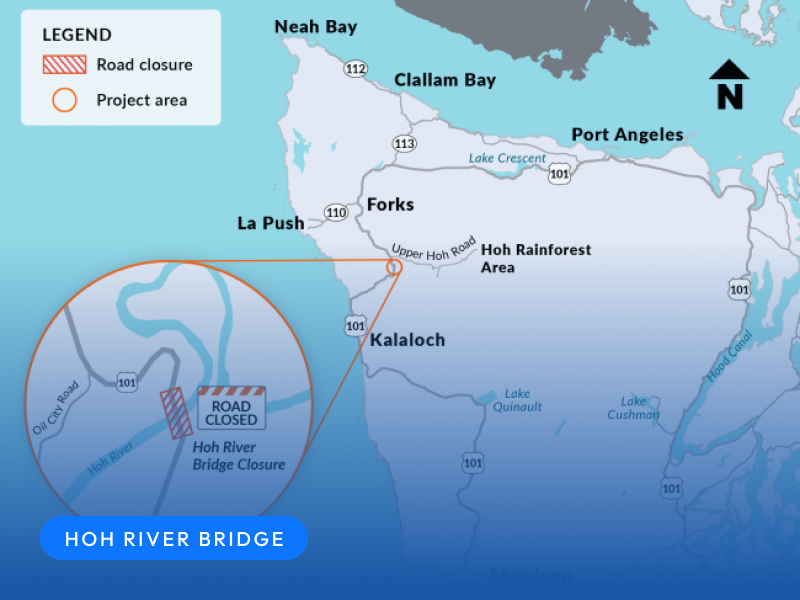
The Hoh River Bridge is part of U.S. 101 south of Forks, on the Olympic Peninsula. During an inspection in early summer 2026, engineers from the Washington State Department of Transportation (WSDOT) found cracks in a support beam and in the steel members under the bridge that support the driving surface.
On July 14, WSDOT restricted traffic to a single lane across the center of the bridge, with temporary signals and a 25 mph speed limit.
The bridge was built in 1931 and is 494.5 feet long. Nowadays 1,400 vehicles cross it every day, but oversized loads have been restricted since 2010. According to WSDOT, it is one of 342 WSDOT bridges older than 80 years (which is the service life expected under current standards).
The emergency repair
In September, WSDOT's emergency contractor started replacing four floor beams at two joints under the deck. Because the bridge is too narrow to keep a lane open next to a work zone, WSDOT closed it three times for six days in a row, and after each closure the bridge was inspected before reopening to single-lane traffic. The work ended on October 13.
According to WSDOT, the bridge can remain open until a long-term repair restores its load-carrying capacity. Until that happens, only single-lane traffic will be allowed.
The project's current timeline is from July 2026 to September 2028. So for about two years the bridge will carry traffic with known damage, part of it repaired and part of it waiting for the long-term work, a situation similar to the one we described for the BQE in New York on a much smaller structure.
During this period, WSDOT will rely on a traffic restriction to limit the load on the floor system and on inspections to check the members of the bridge.
A precedent on the Mississippi
Five years before, on May 11, 2021, inspectors found a fracture in a tie girder of the Hernando de Soto Bridge, which carries I-40 over the Mississippi River between Arkansas and Tennessee, and the bridge was closed.
During the repair, about 44 wireless strain gauges were installed in a matter of days on the high-risk members, to monitor loads while the fractured member was being repaired. After the bridge reopened, the sensors kept monitoring the structure to check that the repairs performed as expected, and according to the Arkansas Department of Transportation part of the strain monitoring system remained active.
On I-40, data collected even before the problem was found also proved useful. Photographs taken by boaters suggested that the fracture had started years earlier, possibly as early as 2016, and researchers at the University of Memphis used vibration data recorded on the bridge from 2016 to 2021 to determine when the cracked element first affected its behavior.
What data would measure at the Hoh River
On the Hoh River Bridge, the most important metric to watch would be the deflection of the floor system under traffic. A sensor like the DECK002-X displacement sensor under a floor beam would be used to record its deflection at vehicle crossings.
Sensors under a repaired floor beam and an unrepaired one also give two series that engineers can then compare, because the same vehicles load both at the same temperature. If the deflection of the unrepaired floor beams grows over the months, the damage is progressing, and the owner learns about it without waiting for the next scheduled visit.
Temperature needs to be part of the measured factors, because steel joints and bearings on an old bridge move with the seasons. As we described for Lake Shore Drive in Chicago, a year of displacement and temperature data shows what normal movement looks like for a specific bridge, and a tiltmeter at the bearings adds the rotation of the spans.
None of this would change WSDOT's current plan, because the long-term repair is still necessary. However, with continuous data, engineers would have evidence, between inspections, that the restriction is effective.
Frequently Asked Questions
Can sensors show whether a crack is growing?
Not directly. Sensors measure the deflection and rotation of the members, and a crack becomes visible in the data only when it changes the stiffness of the member. For that reason inspections remain necessary to measure the cracks themselves.
How long before the data are useful on a repaired bridge?
The comparison between repaired and unrepaired floor beams is useful from the first weeks, because both are measured under the same traffic and temperature. Trends need longer, and a full seasonal cycle separates temperature effects from changes in the structure.
Does monitoring replace the extra inspections on a damaged bridge?
No. Inspections assess the condition of the members, while continuous data show how the structure responds between one inspection and the next and can indicate when an earlier visit is needed.
Other articles




Subscribe to Updates
Stay informed about our latest innovations and insights.