The BQE Is Only the Most Famous One: A Tour of New York's Aging Giants
Join the Move Solutions newsletter
Stay updated on product releases, news, and upcoming webinars.
The most heavily traveled poor-rated bridge in New York State carries about 202,650 vehicles a day. It was built in 1944, and it runs along Furman Street in Brooklyn.
If that sounds familiar, it should: it is the BQE's triple cantilever — the structure whose $4 billion, decade-long rehabilitation we covered in the first article of this series. This August's announcement made it the most talked-about piece of infrastructure in America.
But the cantilever sits at the top of a long list. In the 2025 National Bridge Inventory, 1,741 of New York State's 17,666 bridges are rated in poor condition — 9.9%, well above the national rate of 6.7% — and another 57.9% are rated fair, leaving barely a third of the inventory in good condition. Among bridges maintained by the state itself, 7.6% are poor, compared with 4.4% for all other states combined.
So it is worth asking the question the BQE headlines skip: what else is on that list? Here is a tour of the company the cantilever keeps.
The other hundred-year-old cantilever
Everyone now knows New York has a deteriorating double-deck cantilever from the 1940s. Fewer people remember it has an older one.
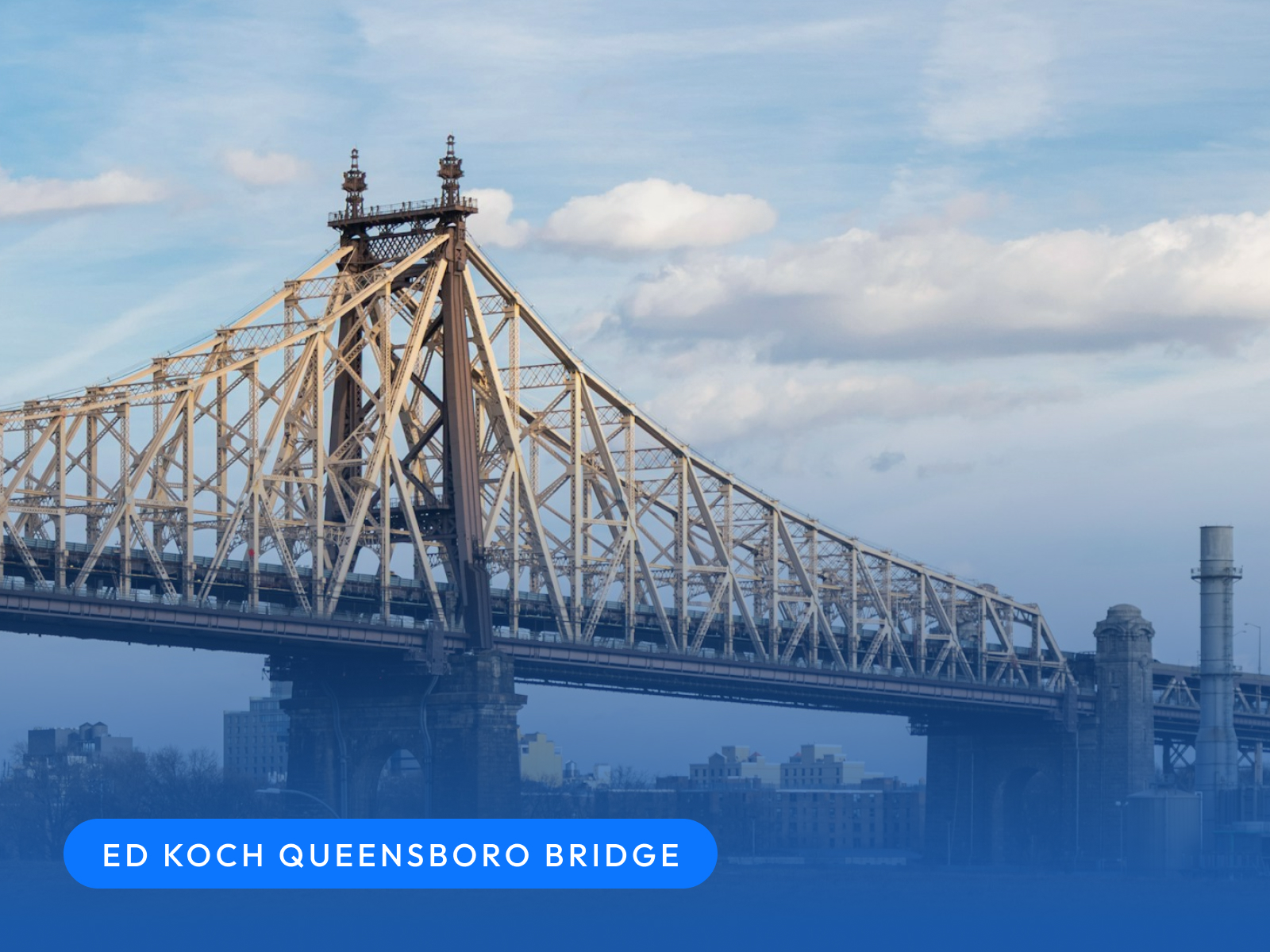
The Ed Koch Queensboro Bridge is a double-decked cantilever completed in 1909 — 117 years in service — carrying roughly 160,000 vehicles a day between Manhattan and Queens. NYC DOT is currently converting its aging upper roadway to lightweight deck panels precisely to extend the bridge's lifespan. Its recent history includes red-flag conditions: in 2018, a truck fire on the bridge damaged three of the stringers supporting the eastbound upper roadway, requiring custom-fabricated steel beams to repair.
A cantilever from 1909, under six-figure daily traffic, being actively re-decked to buy time: structurally, the Queensboro's story rhymes with the BQE's — it just hasn't had its front-page moment.
The landmark
The Brooklyn Bridge is more than 140 years old, a national landmark, and a working piece of the road network. Recent city work has focused on its approach structures and supporting arch blocks — the unglamorous masonry that actually carries the loads. It is the oldest active reminder of the basic fact of New York's inventory: much of it was built for a city, and a truck fleet, that no longer exists.
The elevated interstates
Away from the East River icons, the interstate viaducts of the Bronx and Queens are where poor ratings concentrate. A state-data review counted 30 poor-rated bridges among the Bronx's 309 — including a one-mile elevated stretch of I-278 over Bruckner Boulevard and multiple I-87 and I-95 structures — and 33 among Queens' 509, alongside poor-rated ramps to the George Washington Bridge and a portion of the Triborough complex dating to the 1930s.
These are the BQE's true siblings: mid-century elevated highways, carrying interstate truck traffic through dense urban fabric, with no easy detour and no easy replacement.
The "fair" that isn't fine
The federal rating system compresses each bridge into one word: the overall label is set by the worst of three components — deck, superstructure, substructure — with 4 or below rated poor and 5–6 rated fair.
That compression can hide as much as it reveals. Two New York structures — a segment of the Harlem River Drive near the Macombs Dam Bridge, and part of the Marine Parkway–Gil Hodges Memorial Bridge — carry a scour rating that classifies their foundations as unstable for assessed scour conditions. Both are rated "fair" overall.
A label that can contain both "minor deck wear" and "foundations flagged for scour" is a sorting tool, not a diagnosis. It tells you where a structure sits in the queue. It does not tell you what is happening inside it.
The loads are growing — and the rules are not being followed
Every structure on this list shares one silent assumption: that the loads crossing it stay within the limits it was designed and posted for.
That assumption is failing, measurably. About 16% of trucks weighed in New York State received overweight citations in 2023, up from 11% in 2019. One in six weighed trucks was breaking the rules — and those are only the ones that got weighed.
Why this matters is a question of physics, not paperwork. Structural damage does not grow in proportion to weight: it grows steeply and non-linearly with it. Fatigue in steel and concrete accumulates with every load cycle, and heavier cycles consume a structure's fatigue life disproportionately — a truck at double the legal weight does not do twice the damage of a legal one, but many times more. On a new structure, that margin is absorbed. On a 117-year-old cantilever or a 62-year-old elevated viaduct, the margin is the structure.
And here is the uncomfortable part: enforcement reduces the problem, but it does not eliminate it. Even on the BQE — the only crossing in America with automated weigh-in-motion enforcement, fines, and cameras — overweight crossings dropped from roughly 8,000 a month to about 3,000. That is a success story, and it still means around a hundred overweight trucks a day on the most scrutinized poor-rated bridge in the country.
A weight limit protects a bridge on paper. What protects it in practice is knowing what actually crossed it — and what the structure did in response.
What chronic overloading does, eventually
If that sounds theoretical, there is a case that shows the end of the curve.
In October 2019, a viaduct on China's National Highway 312 in Wuxi overturned without warning, its entire superstructure rotating off its single-column piers and crushing the cars below. Three people died. The two trucks on the span at that moment were carrying steel coils — roughly 170 and 200 tons, on a bridge whose design load class topped out at 55 tons.
The details are what make Wuxi relevant to New York rather than exotic. The bridge was young — opened in 2005 — and its designer stated it complied with codes and standards. The overloading was not a freak event but a local routine: residents told reporters that heavily overloaded steel trucks used that route constantly, some in past years carrying as much as 300 tons. Engineers who reviewed the failure noted that when overloaded vehicles cross a structure frequently, damage accumulates where no one sees it, until stability is lost all at once. And the city had approved a reinforcement plan for that very section three months earlier. The repair was coming. The bridge didn't make it to the date.
One more detail from the engineering commentary deserves quoting in substance: major bridges, the experts noted, carry sensors that track internal stresses and deformation — ordinary bridges rely on periodic checks. The Wuxi viaduct was an ordinary bridge.
New York is not Wuxi; its limits are lower, its enforcement stronger, its inspections rigorous. But the mechanism does not care about geography. Chronic overloading plus accumulated, unmeasured damage is precisely the combination a biennial visual inspection is worst at catching — because between two inspections, the structure keeps count and nobody reads the tally.
The arithmetic nobody should ignore
Now put the tour next to the rescue.
Fixing 1.5 miles of the BQE will cost $4 billion and a decade of construction. NYC DOT alone is responsible for 806 bridge structures; the estimated cost of needed work on the state's locally owned bridges alone runs to about $29 billion. There is no version of the math in which every aging giant on this list gets a BQE: not the money, not the construction capacity, not the decades.
And here is the point: nobody is planning one. The realistic future for most of these structures is not a $4 billion rebuild. It is decades of continued service, managed.
That reframes the economics entirely. A rescue is what a structure costs once deterioration has won: rebuild-level money, a decade of disruption, bypasses through a park. Keeping a structure from ever needing a rescue — maintaining it while it is still maintainable, catching changes while they are still cheap to address — costs a fraction of that. And the instrumentation that tells an owner when and where to intervene costs a rounding error of either figure. The BQE's own numbers make the case: the interim regime of repairs, enforcement, and monitoring bought years of safe service on a poor-rated structure for a minute share of the $4 billion the rescue will cost. Prevention is not just safer than rescue. It is orders of magnitude cheaper — but only if it starts while the structure is still worth preserving.
What actually scales
Which brings the story back to where this series started — because the most interesting thing New York did on the BQE was not the rescue plan. It was the management regime that made waiting for the rescue safe: targeted repairs, automated weigh-in-motion enforcement, and continuous structural monitoring of the cantilever's stiffness, cracking, and vibration.
Unlike the rescue, that regime scales. And New York has already started scaling it — partially. The state has authorized expanding automated weigh-in-motion enforcement to 11 additional locations across the five boroughs, including the Williamsburg Bridge, the Queensboro Bridge, and the Long Island Expressway.
Look closely at what is spreading, though. Of the three legs that keep the BQE safely in service, two — interim repairs and load control — are being extended across the network. The third leg, continuous structural monitoring, remains what it has been all along: the special treatment reserved for the one structure famous enough to earn it.
That is the gap this tour reveals. The Queensboro will get truck enforcement; the Bruckner viaduct waits its turn in the funding queue; the scour-flagged foundations keep their "fair" label until the next inspection. Every structure on this list is being managed on the same bet the BQE stopped making years ago: that nothing important changes between one visual inspection and the next.
Wuxi is what losing that bet looks like. New York proved, on its most notorious highway, that the bet is optional.
Other articles



Subscribe to Updates
Stay informed about our latest innovations and insights.