The Rastatt Collapse and Tunnel Excavation Monitoring Under Live Railways
Join the Move Solutions newsletter
Stay updated on product releases, news, and upcoming webinars.
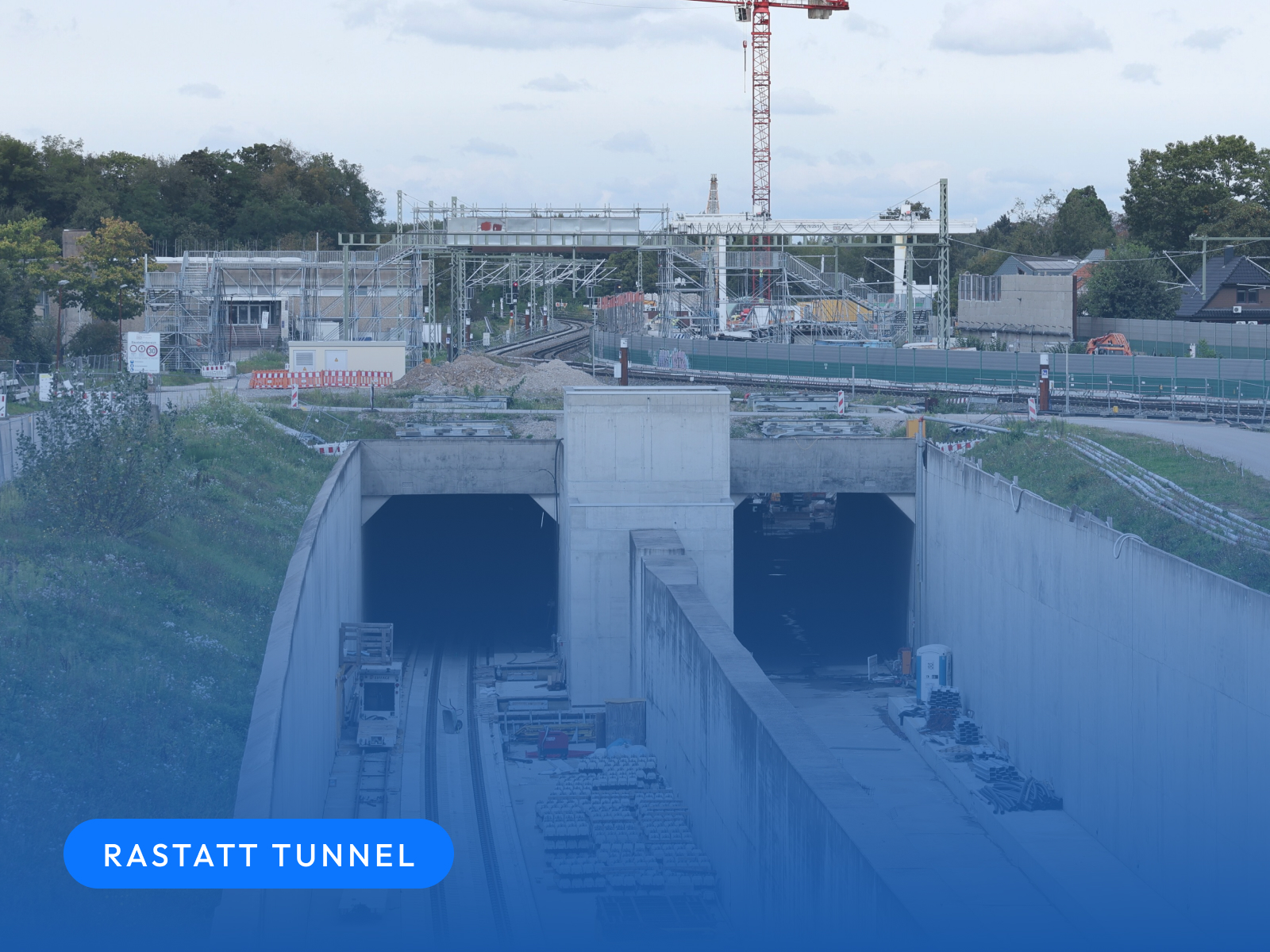
On 12 August 2017, a tunnel boring machine was excavating the eastern bore of the twin-bore Rastatt tunnel, in Germany. The machine passed under the Rhine Valley Railway with about five meters of cover. Shortly after, water entered the bore behind the shield and a section of new tunnel around 50 meters long collapsed. Sensors above ground detected the track lowering, and the signals on the line were set to danger.
Nobody was injured during the accident, and fortunately no train was passing on the track at the moment. However, around 150 meters of track were deformed, and the line between Karlsruhe and Basel had to stay closed until 2 October. According to a study on the impact of the closure, the losses of operators, logistics companies and their customers exceeded €2 billion.
Deutsche Bahn later moved the tracks above the finished western bore so that the eastern bore could be completed from the surface, and the first trains are planned to pass through the tunnel at the end of 2026. For tunnel excavation monitoring under live infrastructure, Rastatt is a useful case because the monitoring of the bore had two functions.
The frozen ground
Since the ground under Rastatt was saturated sand, the engineers had to freeze it before excavating. Brine circulating in freeze pipes at -35 °C turned the ground around the future tunnel into a temporary ring of frozen soil, and the TBM excavated through it. This created a frozen ring that kept the water out and supported the ground until the lining was complete.
The weakness of this method is that the ring has to stay frozen. Shortly after the accident, Rail Engineer reported that the initial assessment pointed to a failure of the freezing under the existing line, with hot summer weather and heavy rain suggested as the likely cause. The investigation that followed, as reported by TunnelTalk, covered freeze management, instrumentation and monitoring, TBM operation and operator logs. In 2018 DB Netz described the accident as unforeseeable for the contractor.
The cause has never been published though. In September 2017 DB and the contractor joint venture of Züblin and Hochtief agreed to establish the causes and the related responsibility through an evidence-gathering and conciliation procedure with technical and legal experts, instead of going to court. According to DB's 2024 interim report, the procedure was suspended for settlement negotiations on the basis of an interim report by the technical expert on the causes, and in the meantime DB settled with the railway companies affected by the closure. In August 2026 the regional newspaper BNN reported that the negotiations had ended without agreement, and the 2017 agreement provided for an arbitral tribunal in that case. As a consequence, nine years after the collapse, the technical findings are known only to the parties.
Sensors can measure and alert about the changes in a frozen ring like the one used in Rastatt. Temperature strings between the freeze pipes show whether the frozen wall is closing or thinning, the return temperature of the brine shows how much heat the circuits are extracting, and piezometers outside the ring show whether groundwater is moving toward the excavation. When these quantities start changing, the contractor can stop the TBM, add freezing capacity or inject the ground before the excavation reaches the weak zone. Most of these instruments have analog outputs, but devices like the Communication Node (SCN-XXX-LR-2) can digitize up to eight analog channels and send them over LoRaWAN, so their readings can be analyzed in MyMove together with the data from the track above.
Track monitoring above the drive
Monitoring the frozen ring is one job for sensors, but the train tracks above the excavation also need to be protected and monitored, which is exactly what was done in Rastatt. Tiltmeters fixed to the sleepers measure cant, and the difference in cant between two sleepers a known distance apart gives the twist over that base. The Railway Tool in MyMove computes both from TLT-STD-LR-2 tiltmeters, and alarms on twist can be set at the thresholds the infrastructure manager uses for speed restrictions and closures.
Track sensors protect trains only if their alarm reaches someone who can stop them. The sensors have to send readings within minutes, the readings have to cross the threshold while the movement is still small, and the alarm has to reach the signaller or the control center. At Rastatt the sensors detected the movement in time for the signals to be set to danger, and no train ran over the track while the ground was opening underneath. Before the line reopened on the two concrete slabs built over the bores, DB also installed track monitoring systems to protect traffic for the rest of the construction.
Two functions, two decisions
Track sensors could not have prevented the closure, because by the time the track moved the tunnel under it had already failed. At Rastatt they made it possible to set the signals to danger, so that no train could run onto the deformed track. The seven weeks of closure, the concrete slabs built to carry the line over the bores, and the roughly 10,500 cubic meters of concrete pumped into the bore, burying the TBM, were consequences of the collapse itself, and only sensors on the frozen ring could have anticipated it.
For an owner allowing a tunnel under a live asset, the contractor and the operator need different data on different time scales. The contractor reads the ground and support data over hours and days to control the construction, while the operator needs the track data at the control center within minutes. When engineers analyze both datasets in the same platform, a drift in the ground data can raise the alert level on the track before the track moves, a link that two separate systems often lack.
Frequently Asked Questions
Could track monitoring alone have prevented the Rastatt closure?
No. Track sensors measure the consequence of a failure underneath, so they can protect the trains but cannot prevent the collapse. To prevent the closure, the contractor would have needed a warning from sensors on the frozen ground, in the groundwater or on the lining before the track moved.
How often should track geometry be read during a drive under a live line?
Often enough that a movement can be detected, confirmed and reported to the control center before the next train arrives. On a busy line, the sensors should send readings at intervals of a few minutes while the face passes under the tracks and until the lining is grouted, and less often once the readings have stabilized.
Can wireless tiltmeters stay on the track during a TBM drive?
Yes. Battery-powered tiltmeters fixed to the sleepers need no cabling along the track, so they can be installed in a short possession and stay in place for the whole drive and the settlement period after it. The limit is ballast maintenance, because the tamping machine moves the sleepers and changes the reference of the sensors fixed to them, so a new baseline is needed after tamping.
Other articles


Subscribe to Updates
Stay informed about our latest innovations and insights.