What the SNBI Changes in Bridge Inventory Data
Join the Move Solutions newsletter
Stay updated on product releases, news, and upcoming webinars.
On May 6, 2022, FHWA published the update of the National Bridge Inspection Standards (NBIS), which incorporated by reference the Specifications for the National Bridge Inventory (SNBI).
The new specifications replace the 1995 edition of the Recording and Coding Guide, which had defined how bridges were described in the National Bridge Inventory for almost thirty years.
According to the FHWA implementation memo, the transition will take three annual submittals. The first, due March 15, 2026, was a transitioned or hybrid dataset, and so is the second, due March 15, 2027, with temporary codes accepted in both. The submittal due March 15, 2028 must be the first complete SNBI-based dataset, with collected and verified data for all bridges and no temporary codes. After that date, FHWA will no longer accept transitioned data.
New condition ratings
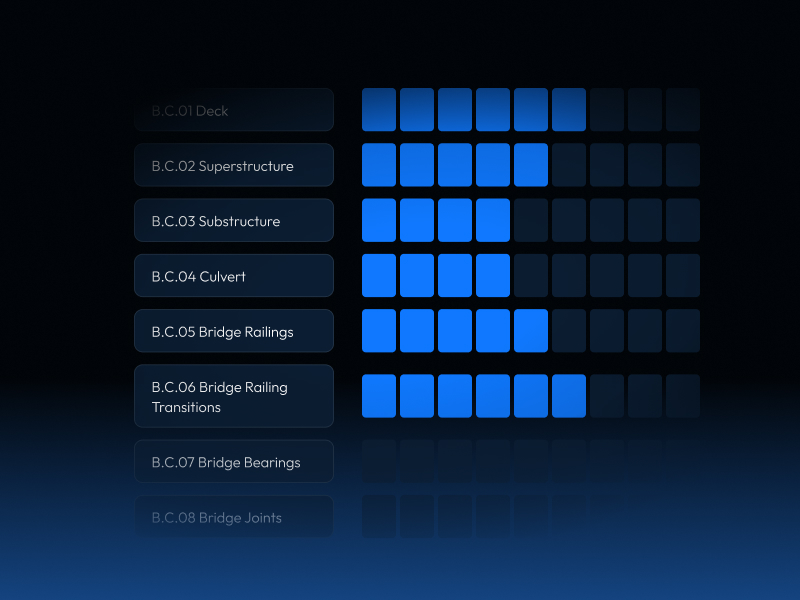
Under the Coding Guide, the condition of a bridge was summarized mostly in four ratings, for deck, superstructure, substructure and culvert. The SNBI keeps those and adds new component ratings for bridge railings (B.C.05), railing transitions (B.C.06), bearings (B.C.07), joints (B.C.08), channel protection (B.C.10) and scour condition (B.C.11). It also adds items for the condition found in nonredundant steel tension member (NSTM) inspections and in underwater inspections.
Joints and railings, which the Coding Guide treated as part of the deck, are now their own components. The SNBI also rewrote the condition rating descriptions, and state training material warns inspectors that some bridge ratings will change even when the bridge itself has not changed.
At the poor end of the scale, the SNBI describes a condition that typically requires more frequent monitoring, load restrictions or corrective actions, so monitoring is part of the language of the specification itself.
Scour and load rating
The old Item 113, which classified bridges as scour critical, is replaced by three appraisal items, scour vulnerability (B.AP.03), scour plan of action (B.AP.04) and overtopping likelihood (B.AP.02), next to the new scour condition rating. For the first time, the inventory records whether a scour plan of action exists, separately from the vulnerability rating.
Load rating data become more detailed too. Inventory and operating rating factors (B.LR.05 and B.LR.06) are reported to FHWA, together with legal load rating factors (B.EP.02), the posting type (B.EP.03) and the load posting status (B.PS.01).
What has to be collected before 2028
FHWA moved the existing NBI data into the new format, but some fields have to be filled from scratch, because they hold data that had never been recorded before. Those items start as empty fields and must be populated with SNBI data before the March 2028 submittal, and the new ratings for bearings and joints are among them.
In practice, this means a full SNBI inspection on almost every bridge before the deadline. Indiana, for example, told its inspectors that bridges with a 2027 inspection must have full SNBI inspections completed and approved by December 31, 2027, so that the 2028 dataset contains no temporary codes.
Where measured data fit
The SNBI is still a record built on inspections, with ratings assigned by inspectors at intervals. However, several of the new components are moving parts of a bridge like bearings and joints.
This is where continuous data support the new ratings. A tiltmeter at a bearing line records the rotation of the span through the day and the seasons, and a DECK002-X displacement sensor across a joint records how it opens and closes with temperature.
As we described for Lake Shore Drive in Chicago, a year of these data shows what normal movement looks like for a specific bridge, so the inspector who rates a bearing or a joint has evidence of how it works, not only of how it looks.
Frequently Asked Questions
Does the SNBI require continuous monitoring?
No. The SNBI defines how inspection and inventory data are recorded and reported, and monitoring appears in the condition descriptions as one of the typical responses to a component in poor condition, not as a requirement.
Will the SNBI change the condition ratings of existing bridges?
It can. The condition rating descriptions were rewritten, and state training material notes that some ratings will be slightly lower or higher under the SNBI than under the Coding Guide, even for bridges whose condition has not changed.
When does the transition end?
Temporary codes are accepted in the 2026 and 2027 submittals. The March 15, 2028 submittal must be a complete and verified SNBI dataset for all bridges reportable to the NBI.
Other articles




Subscribe to Updates
Stay informed about our latest innovations and insights.