Thermal Expansion Shut Lake Shore Drive for 4.5 Hours
Join the Move Solutions newsletter
Stay updated on product releases, news, and upcoming webinars.
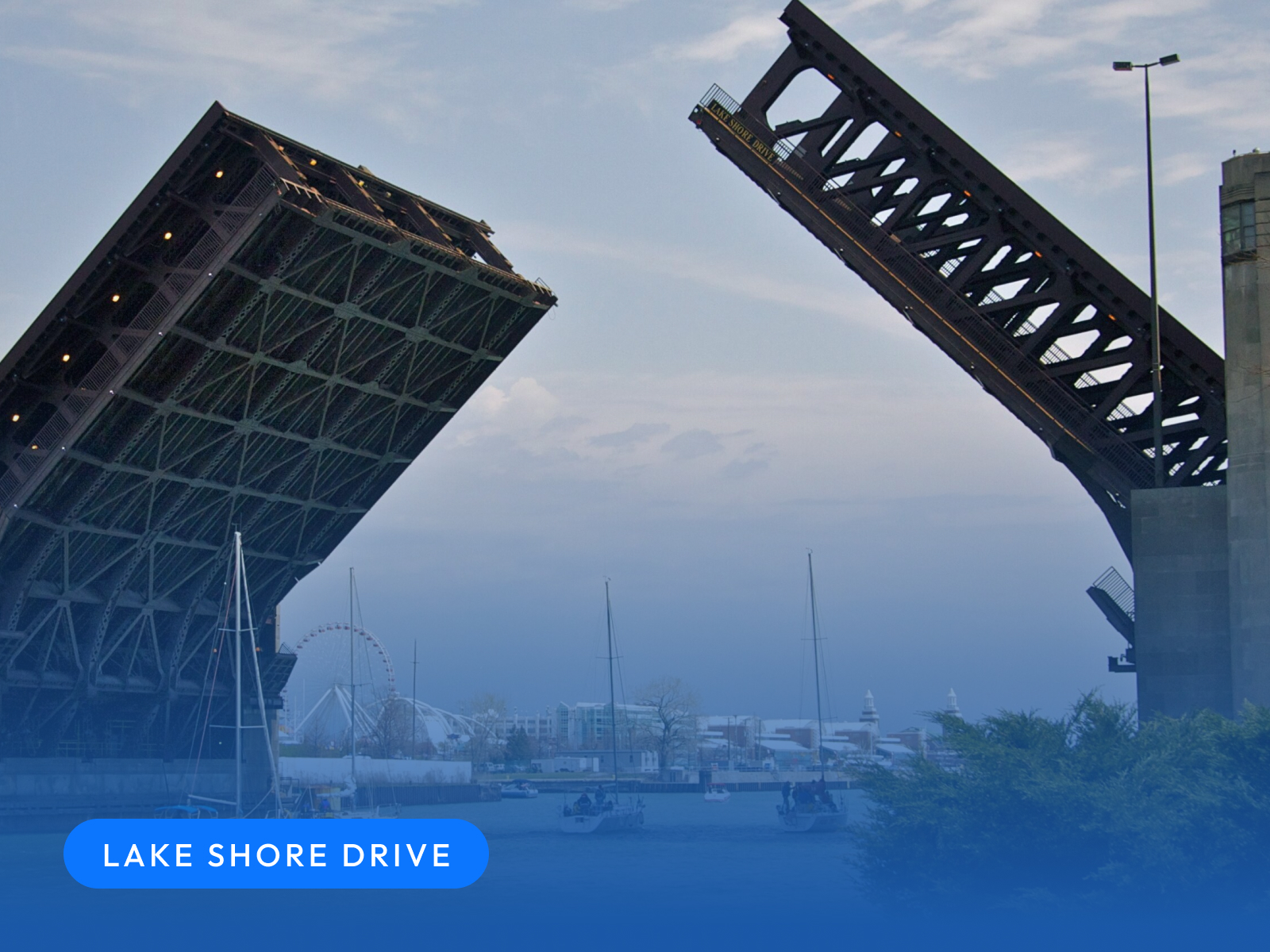
On September 2, 2026, bridge thermal expansion jammed Chicago's DuSable Lake Shore Drive bascule in the open position for four and a half hours, and a second drawbridge on Torrence Avenue a few hours later. For the general public, this story is presented as an effect of extreme heat, but from the point of view of infrastructure maintenance, the bridge's expansion was perfectly foreseeable and the bridge should have not been lifted without precaution during the hottest day of the year.
What happened on September 2
At around 10 a.m. on September 2, 2026, the DuSable Lake Shore Drive bridge over the Chicago River was raised for a scheduled boat passage and could not close again. The Chicago Department of Transportation attributed the jam to high temperatures expanding components enough to prevent the two leaves from fully closing.
The issue was resolved after hours with a fire boat that spent hours pumping water across the steel span to cool it, and the bridge reopened shortly before 2:30 p.m., with the air at 96°F (36°C). The very same afternoon, the Torrence Avenue bridge over the Calumet River was stuck in the raised position and stayed there for an hour.
The DuSable bridge, dedicated in 1937 as the longest and heaviest double-leaf bascule in the world at 6,420 tons per leaf, carries one of the densest traffic corridors in the city.
The 2024 inspection report
A September 2024 inspection rated the bridge's superstructure in poor condition with advanced deterioration, classified the structure as deficient and functionally obsolete, and scored its structural evaluation as intolerable and a high priority for correction. The bridge had already been closed for more than a day in 2019 after inspectors found cracked beam joints. It is one of roughly 100 Chicago bridges, about one in six, rated in poor condition in federal inspection records.
A deficient rating does not mean a bridge is about to collapse, but that the design margins that absorb abnormal load, thermal or otherwise, have been eaten away by deterioration. DePaul University transportation scholar Joseph Schwieterman commented on the September failure as an old structure with tolerances drifted out of line, hit by temperatures beyond what was left of its allowance.
Under the US National Bridge Inspection Standards, a bridge in poor condition must be inspected at least every 24 months (23 CFR 650.311). The DuSable bridge was following that cycle correctly. However, inspections cannot help during the daily functioning of a bridge they are snapshots of the overall health and state of a bridge, and do not provide enough information on how exactly the bridge is reacting to extreme conditions on a specific day.
What heat does to a degraded bascule
Drawbridges jam in heat because steel leaves move toward each other faster than allowed by the closing tolerances. AASHTO puts the coefficient of thermal expansion for steel girder bridges at 6.5×10⁻⁶ per °F. On a 200-foot (61 m) bascule leaf, a 36°F (20°C) rise above the temperature at which the leaves were fitted adds roughly 14 mm of length, against mating surfaces at the center lock machined to tolerances of a few millimeters.
During a hot day, the direct sun heats up the steel and the deck plate, which can rise up to 30 to 50°F (17 to 28°C) above the shade reading. Work by Lauren Linderman at the University of Minnesota, built on monitoring data the I-35W St. Anthony Falls Bridge has produced since 2008, identifies the thermal gradient as the principal damaging effect for bridges. The sun-heated top of the deck expands while the shaded underside does not, bowing the leaf, so it meets its twin at the wrong length and the wrong angle at the same time.
While a healthy bridge is designed to bear such temperatures, a degraded structure consumed its margins because of corrosion, seized bearings, packed expansion joints, and drifted tolerances. The poor state of the bridge revealed in the 2024 report and the situation that occurred on September 2 are both caused by the lacking health of the structure.
Between two inspections
The CDOT canceled scheduled river lifts during a June 2022 heat wave to prevent these types of failures. It was a decision made using weather forecasts and applied as a blanket rule across all bridges. It is well known that these types of bridges can face problems during heat waves.
But there could be a more granular approach to these problems than blanket bans on river lifts. A year of displacement and structure-side temperature data establishes what normal expansion looks like for that specific structure, in millimeters per degree. A wireless displacement sensor such as the DECK002-X paired with structure-side temperature measurement offers correlation, and a tiltmeter on each leaf or pier resolves the rotation a gradient-bowed span develops.
With that baseline, an operator who can read the joint gap and the steel temperature at 9 a.m. does not have to guess from an air forecast whether the 10 a.m. lift will close again. And a structure whose millimeters-per-degree slope drifts year over year has joints and bearings that are seizing, so engineers need constant information about the state of the bridge.
Continuous monitoring would not have repaired the DuSable bridge, but it would have given engineers enough information to know when not to lift the bridge.
Other articles




Subscribe to Updates
Stay informed about our latest innovations and insights.