Why did the Morandi bridge collapse?
Join the Move Solutions newsletter
Stay updated on product releases, news, and upcoming webinars.
On 14 August 2018, a 210-metre section of the Polcevera viaduct in Genoa, known as the Morandi Bridge, collapsed during a rainstorm. Forty-three people died in the tragic accident. Soon after, the Morandi bridge collapse became the reference disaster for European infrastructure management, and in Italy it caused the government to rewrite the rules for how existing bridges are assessed and monitored.
The design
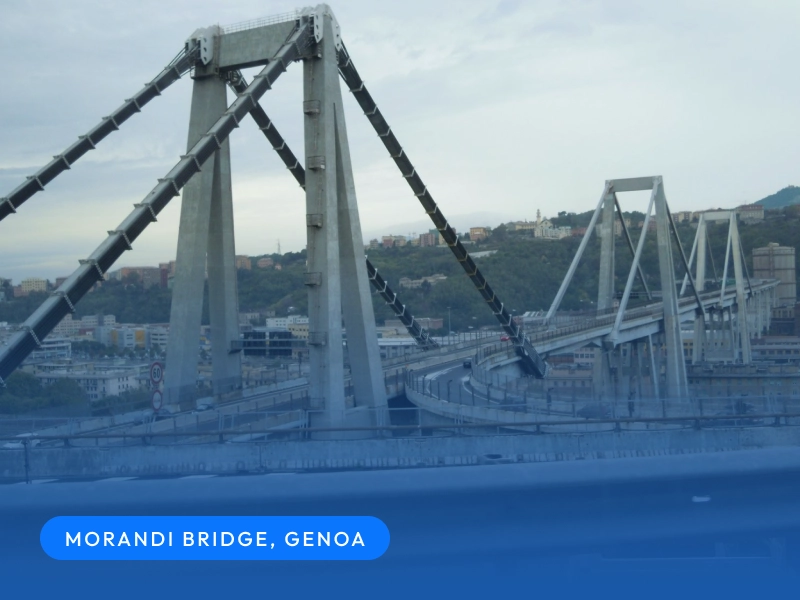
Riccardo Morandi's viaduct, opened in 1967, used a cable-stayed scheme with a deliberately small number of stays. Each of the three main pylons carried the deck on four stays, two per side. A conventional cable-stayed bridge distributes the deck load across dozens of stays, so losing one changes the load path without ending the structure. On the Morandi scheme, by contrast, each stay was a primary element with no backup.
Morandi also encased the steel strands of each stay in prestressed concrete shells, poured around the tendons and compressed to roughly 10 MPa. The intention was to protect the tendons, concrete as a corrosion barrier and a damper on fatigue oscillations. However, unfortunately, the prestress level was too low for the job. At 10 MPa the shells cracked under service loads, water and chlorides entered, and the concrete that was supposed to protect the steel ended up sealing it off from every form of visual inspection instead.
Italy has thousands of prestressed concrete bridges from the 1960s and 1970s with tendons enclosed in the section. Their primary elements have no redundancy and critical cross-sections cannot be inspected. Most of them are fine, but the Morandi bridge was also considered "gine" until 14 August 2018.
The failure
The official investigation located the initiating failure in the upper portion of the southern stay of pylon 9, on the Genoa side. The strands showed a long-term, generalised corrosive state driven by moisture together with sulphides and chlorides. In the most degraded sections nearly all the strands were affected, with the resistant steel area reduced far below what the stay needed. A forensic study of the ruptured stay compared residual capacity at the time of collapse with the imposed demand and found the margin effectively consumed, which is why the stay failed under ordinary traffic rather than under any exceptional load.
In the early 1990s, corrosion had been found in the stays of pylon 11, the southernmost tower. Those stays were retrofitted with external steel cables flanking the original concrete-encased tendons. Pylon 10 received a partial intervention, and the same retrofit for pylons 9 and 10 finally went out to tender in May 2018 as a 20 million euro project. The bridge collapsed before the work could start.
Instrumented checks did exist, but they underestimated the damage. Reflectometric tests run on the pylon 9 stays from 2015 onward estimated average section losses of 10 to 20 percent in the tested strands. The post-collapse examination found losses several times larger in the critical zone. The worst corrosion was not in the parts that the investigative method could find.
There was no continuous record of the structure's global health. It's important since a stay losing cross-section loses stiffness, and a pylon whose stay is softening redistributes load and shifts its dynamic signature over years. Whether a modal monitoring system on pylon 9 would have produced an unambiguous alarm early enough is not provable. But it is certain that the operator was making retrofit scheduling decisions about a known-vulnerable element with no data stream describing how that element was behaving.
The regulatory changes
The collapse exposed the absence of any uniform national method for assessing existing bridges. Each operator used its own criteria, inspection intervals and intervention thresholds. The Consiglio Superiore dei Lavori Pubblici approved the Linee Guida for existing bridges in April 2020 and the Ministerial Decree 578 of December 2020 made them mandatory for ANAS and motorway concessionaires. Decree 204 of July 2022 extended the pilot programme to municipalities, provinces and regions, and a December 2024 decree moved the end of the pilot period to 29 December 2026.
The Guidelines set up a six-level triage, from a census of every structure (Level 0) through visual inspection (Level 1), risk classification (Level 2), preliminary and detailed verification (Levels 3 and 4), up to network-level resilience analysis (Level 5). Structures classified Medium High or High in Level 2 are the ones where structural monitoring applies, either periodic campaigns or continuous acquisition with alarm thresholds. The full mechanism is covered in our guide to the Italian regulatory framework.
Now prestressed concrete bridges with internal tendons must undergo special investigations beyond visual inspection, including ground-penetrating radar to locate tendons, ultrasonic testing, and endoscopy to check grout condition. And monitoring data must be interpreted against environmental measurements, because on a typical concrete bridge seasonal thermal variation moves modal frequencies by 2 to 10 percent, more than most damage signatures.
The replacement structure, the San Giorgio bridge, opened on the same site in August 2020 and carries roughly 240 fibre-optic sensors reading deck displacement, pier inclination and vibration continuously, plus weigh-in-motion measurement of the traffic crossing it and robotic inspection units running the length of the deck.
Continuous monitoring did not become a legal replacement for inspection, and it should not be treated as one. Sensors capture slow modal drift and transient overloads, while inspectors find local corrosion, bearing damage and human-error defects.
Frequently Asked Questions
Would continuous monitoring have prevented the Morandi collapse?
A modal monitoring system on pylon 9 would plausibly have shown a drifting signature as the stay lost section, one more input pushing the retrofit earlier. But corrosion inside grouted shells can consume a large fraction of the steel before the global stiffness change becomes clear, and the retrofit was already at tender.
Why did fifty years of inspections miss the corrosion?
The strands were cast inside prestressed concrete shells, so there was nothing for an inspector to see. The condition of the steel was only accessible through indirect methods. Reflectometric testing from 2015 onward estimated average section losses of 10 to 20 percent on the strands it could reach, several times less than the loss later found in the failure zone.
Does the MIT 2020 framework require monitoring on every Italian bridge?
No. Every bridge must be censused, inspected and classified, but structural monitoring applies to structures whose Attention Class comes out Medium High or High. Prestressed concrete bridges with internal tendons additionally require special investigations (radar, ultrasonics, endoscopy) regardless of visual condition, because Morandi-type degradation is invisible from the surface. The pilot period ends on 29 December 2026.
Is the replacement bridge monitored differently?
Yes, by design rather than by retrofit. The San Giorgio bridge carries around 240 fibre-optic sensors measuring displacement, tilt and vibration continuously, weigh-in-motion sensors recording traffic loads, and robotic units for physical inspection.
Other articles




Subscribe to Updates
Stay informed about our latest innovations and insights.