How to Choose a Structural Accelerometer: MEMS vs Force-Balance

Join the Move Solutions newsletter
Stay updated on product releases, news, and upcoming webinars.
There are two types of structural accelerometers that can be used for monitoring infrastructure: MEMS and force-balance sensors. MEMS sensors are less sensitive and consume less energy, while force-balance servo accelerometers can resolve very low noise numbers that can be useful even for volcano monitoring, but the technology inside the sensor makes it power-hungry.
MEMS vs force-balance
A capacitive MEMS accelerometer is a silicon proof mass a few micrometres across, suspended on micro-machined springs and read as a change in capacitance between interdigitated fingers. The whole device is etched on a chip, factory temperature-compensated, and runs on microwatts during sleep.
A force-balance accelerometer doesn't let the proof mass deflect, it holds the mass at its null position with a closed feedback loop, and the current the coil needs to hold it there is the output. The servo loop bypasses the mechanical limits of a free mass, which is what gives force-balance its excellent near-DC behaviour and very low broadband noise. It also means the loop needs to be kept powered all the time.
For a long time, force-balance accelerometers were clearly superior to MEMS sensors, because of the low-noise characteristic of the former. Nowadays, MEMS sensors have become more sensitive and reach µg/√Hz sensitivity, with the best research-grade devices around 0.7 µg/√Hz, which is comparable to the best-in-class force-balance sensors available.
The four important parameters
There are four important parameters that engineers try to optimise for accelerometers: noise density, bandwidth, power and cost.
Noise density (µg/√Hz)
Noise density is the smallest acceleration the sensor can resolve in a given bandwidth. Civil modes are low-frequency and low-amplitude. For example, the dynamic response of a bridge deck under ambient traffic is in the milli-g range, while it can be a few hundredths of a g or less on stiffer elements.
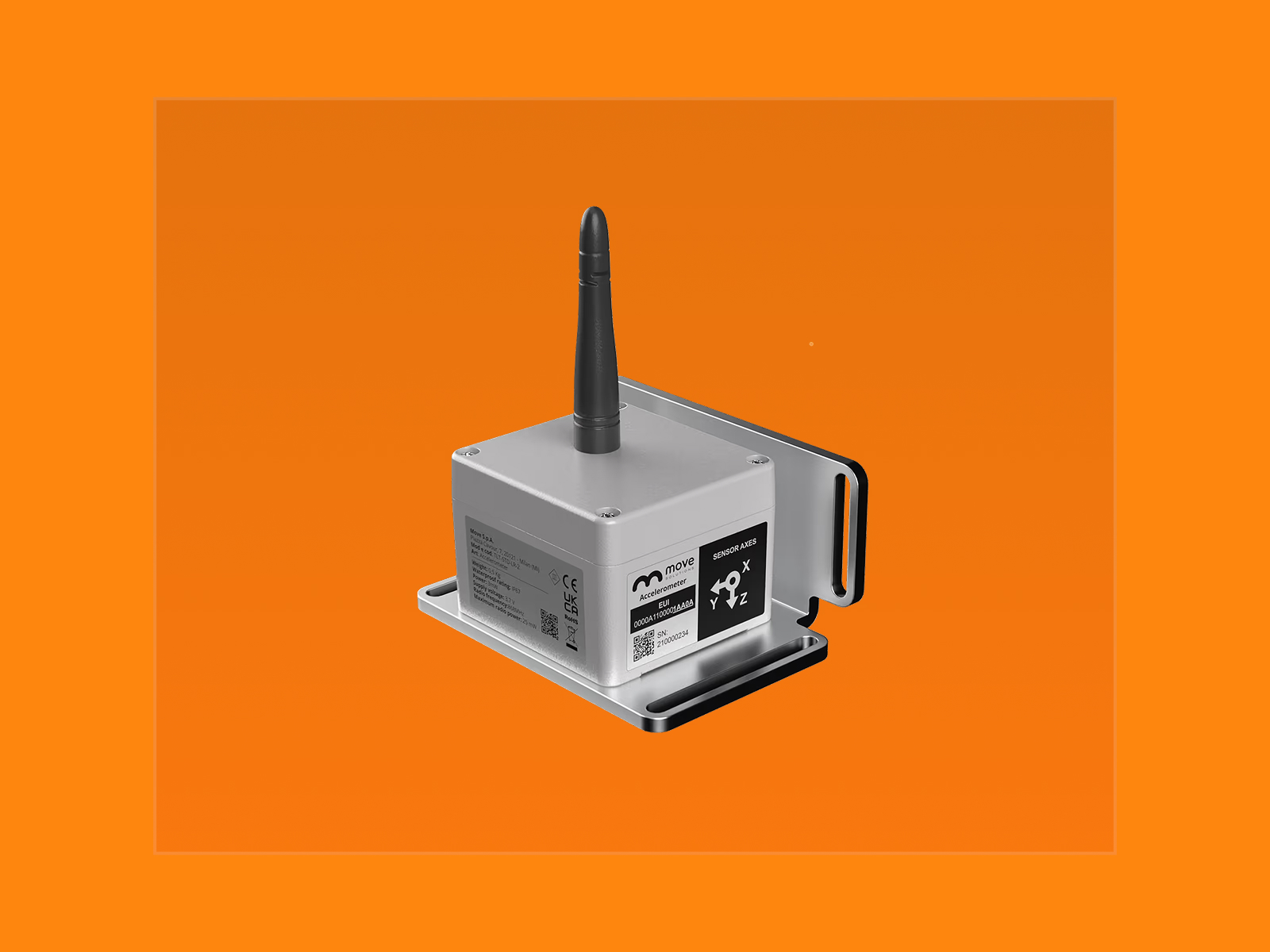
The academic literature sometimes quotes a self-noise target under 1 µg/√Hz, and preferably nearer 0.5 µg/√Hz, for the most demanding low-amplitude modal work on an almost-silent structure. But civil infrastructure is barely ever silent, as it is excited by traffic. On a typical medium-span deck we run the DECKAXE-SHM at deck mid-span, with a noise density around 22.5 µg/√Hz, and that floor is well under the milli-g response the deck produces under live load. In side-by-side bridge tests a MEMS node of this class has matched a high-sensitivity piezoelectric reference to within a fraction of a percent on the identified natural frequencies. The MDPI Sensors review of sub-µg/√Hz micromachined accelerometers documents how low the MEMS floor can now go, but these floors are becoming more than necessary for civil structures.
Bandwidth
The natural frequencies of bridges and buildings are between 0.1 and 10 Hz, and the modes that matter for damage detection are clustered low. The DECKAXE-SHM offers selectable sampling up to 640 Hz (40, 80, 160, 320 and 640 Hz steps), but modal work on large civil structures rarely needs the top of that range. You set a higher sampling rate to keep margin above the modes of interest and to catch the occasional stiff local element.
Increasing bandwidth cannot be done without limits, because it sacrifices the sensitivity of the sensor. The mechanical sensitivity of an accelerometer scales inversely with the square of its resonant frequency, so a device advertised with a very wide band has almost certainly traded away low-frequency sensitivity to get there. For a 2 Hz bridge mode that trade is exactly backwards.
Power and battery life
Nowadays the difference between a force-balance accelerometer and a MEMS accelerometer is mainly important because of their power consumption. A force-balance accelerometer runs its servo loop continuously, so it draws current whether or not anything is happening on the structure. This makes these sensors suitable when there is a power source already available for the sensor to use.
A MEMS wireless node spends most of the time in sleep, which consumes small amounts of power in the microwatt range. Waking only to sample allows these accelerometers to run for years on a single battery pack. Since monitoring systems are usually meant to last for years, sensors that survive five or more years untouched reduce costs and keep the data continuous.
Cost
A force-balance accelerometer typically costs ten to fifty times a comparable MEMS device, which means that a MEMS-based system will scale much better. Also, having a MEMS battery-powered system means no cables need to be installed, which also greatly reduces the installation costs.
Where force-balance accelerometers should be used
Force-balance accelerometers are still needed where the signal approaches the deformation-grade and near-DC regime. Applications like strong-motion seismology, tectonic and fault monitoring, volcano deformation and other ultra-low-frequency, static-leaning measurements require a servo sensor.
Frequently Asked Questions
What noise floor does Move Solutions specify for a medium-span road bridge, and why not go lower?
We deploy the DECKAXE-SHM, with a noise density around 22.5 µg/√Hz, at deck mid-span and the quarter-spans. That floor already sits comfortably below the milli-g response the deck produces under live traffic, so it resolves the modes with margin to spare, and in side-by-side tests this class of node has tracked a high-sensitivity piezoelectric reference to within a fraction of a percent on the identified frequencies. Going to a single-digit or sub-µg/√Hz floor would buy resolution the structure never exercises, while costing more money and more power, which on a permanent wireless network is the resource that actually constrains you.
Is a low-cost MEMS board ever acceptable for a permanent SHM deployment?
For a permanent network that collects legally-required data, no. Consumer-grade MEMS typically sits in the tens of µg/√Hz, far above what a quiet civil structure needs, and at that floor the ambient modes are buried in sensor noise. Low-cost boards have a place in teaching, prototyping and very high-amplitude alerting, but a sensor of record on a bridge is a low-noise, calibrated part.
Does a higher sampling rate buy better modal results, or just bigger data bills?
Mostly bigger data bills. Civil modes are roughly between 0.1 and 10 Hz, so more hertz adds storage and transmission load without adding structural information. The DECKAXE-SHM goes to 640 Hz for the cases that need it, but most bridge modal work runs far below that, and its data feeds the Modal Analysis Tool in MyMove without drowning the network.
Other articles


Subscribe to Updates
Stay informed about our latest innovations and insights.