What Is a Structural Accelerometer and How Is It Used in SHM?
Join the Move Solutions newsletter
Stay updated on product releases, news, and upcoming webinars.
A structural accelerometer is the sensor that tells you how a structure actually moves under the loads it carries every day. Elements like traffic, wind, a passing train and a small earthquake all excite the structure, and the way it responds carries the signature of its current condition.
What a structural accelerometer measures
Acceleration is expressed in g (1 g = 9.81 m/s²) or in fractions of it, and the dynamic response of a bridge deck under ambient traffic sits in the milli-g range. Meanwhile on a stiff, lightly loaded element you are chasing accelerations of a few hundredths of a g or less. Bridge monitoring work routinely deals with amplitudes as low as 0.04 g and below.
Most structural accelerometers are triaxial. They report acceleration along three orthogonal axes at once, which is what you need on a structure that twists, sways and bounces in directions you did not fully predict at design time.
Some accelerometers respond down to DC, meaning they sense the static component of acceleration, including the constant pull of gravity. Others are AC-coupled and see only the dynamic part. For modal work on infrastructure you care about the dynamic band, typically from a fraction of a hertz up to a few tens of hertz, because that is where you find the structural modes of large civil works. The natural frequencies of bridges and buildings generally fall in the 0.1 to 10 Hz window.
How it works
In an accelerometer, a known proof mass is suspended on a compliant element, and when the housing accelerates, the mass lags behind. That relative motion is transduced into an electrical signal proportional to the acceleration. The differences between accelerometer technologies are differences in how the mass is suspended and how the motion is read out.
In a MEMS device the proof mass is a silicon structure a few micrometres across, suspended on silicon springs and read capacitively. Move the mass and the gap between a set of interdigitated fingers changes, and that capacitance change becomes a voltage. The whole sensor is etched on a chip, factory temperature-compensated, and runs on microwatts.
The mechanical sensitivity of an accelerometer scales inversely with the square of its resonant frequency. Push the resonant frequency up to get more bandwidth and you lose sensitivity at the same rate, which raises the relative noise floor at the low frequencies you actually care about.
The main types of structural accelerometer
Four sensing principles cover almost everything you will meet on a structure. They differ in how the proof mass is suspended, whether they respond down to DC, and where they sit on the noise-versus-cost curve.
Capacitive MEMS
A silicon proof mass on silicon springs, read as a change in capacitance. These respond down to DC, run on microwatts, tolerate vibration and shipping, and arrive factory temperature-compensated. Low-noise parts now reach the µg class. This is the standard for civil structural monitoring and covers the large majority of permanent wireless deployments.
Piezoelectric (IEPE)
A crystal generates charge when the proof mass stresses it. These hold a very low noise floor across a wide band and are the reference for high-frequency, low-amplitude and laboratory work. They are AC-coupled, so they do not see static or near-DC components, and they need constant-current powering and cabling, which is what keeps them tied to wired installations.
Piezoresistive
A micromachined flexure carries a strain-gauge bridge whose resistance changes with acceleration. These respond down to DC and handle high-g and long-duration events well, which makes them the tool for impact, crash and blast measurement. At the milli-g amplitudes a quiet bridge produces, their sensitivity is usually too low to be the primary SHM sensor.
Force-balance (servo)
A pendulum is held at null by a closed feedback loop, and the current needed to hold it is the output. The low-frequency and DC performance is excellent and the noise floor is very low, which is why these are the reference for strong-motion seismology and high-end structural arrays. They are expensive and power-hungry, and out of scale for a routine wireless network.
For permanent civil SHM the realistic contest is capacitive MEMS against IEPE piezoelectric, which is the choice the next section unpacks.
MEMS vs piezoelectric
There is no single best accelerometer technology, there is a best fit for the deployment. For permanent civil SHM, our position at Move is that wireless MEMS is the right default, and the rest of this section explains why we hold it and where we would disagree with ourselves.
MEMS
MEMS accelerometers are small, low-power, vibration-tolerant and cheap enough to instrument a structure at several points without straining the budget. Modern low-noise parts close most of the historical performance gap. In side-by-side bridge tests a MEMS node has matched a high-sensitivity IEPE piezoelectric reference to within a fraction of a percent on the identified natural frequencies, at a small fraction of the cost and power. For a sensor that has to sit on a pier for ten years and survive on a battery, low power consumption is absolutely crucial as it maintains sampling continuity and reduces the need to send operators to change the battery.
Piezoelectric (IEPE)
A piezoelectric accelerometer generates charge when a crystal is stressed by the proof mass. These sensors keep a very low noise floor across a wide frequency band and remain the reference for high-frequency, low-amplitude work and for laboratory-grade characterisation. They are AC-coupled, so they do not see static or near-DC components, and they want constant-current powering and cabling. That's why these sensors are not ideal for a wireless retrofit system across a 300-metre viaduct.
From raw acceleration to structural insight
The standard analysis for in-service infrastructure is operational modal analysis (OMA), which extracts the modal parameters of a structure from its response to ambient excitation alone, with no shaker and no controlled input. Traffic, wind and microtremor do the exciting, and the algorithms (frequency-domain decomposition, stochastic subspace identification) recover the modes.
Modal analysis gives you a set of natural frequencies, the mode shapes and the damping ratios, which indicate stiffness. When this stiffness decreases, because of cracking, corrosion, bearing seizure or fatigue, the natural frequencies of the structure drop and the mode shapes distort in the affected region. Continuous monitoring turns this physics into a maintainable signal. You track the modal frequencies over months and years and you watch the general trend.
Field campaigns have documented gradual reductions of roughly 5% in the first natural frequencies of a structure over an extended monitoring period. Of course, this is exactly the kind of slow drift that an inspector standing on the deck will not feel. A modal identification on a real bridge can pull the first several mode frequencies with relative errors in the low single digits, which is tight enough to make a few-percent shift meaningful rather than noise.
Where are structural accelerometers used?
Bridges and viaducts
The bridge deck is the classic application for an accelerometer. A network of triaxial accelerometers at mid-span and the quarter-spans captures the vertical, lateral and torsional modes, and tracking those modes over time reveals invisible scour at a pier, a frozen bearing or developing fatigue. On Chetwynd Bridge in the UK we ran continuous wireless modal monitoring of exactly this kind, and on the Zambeccari Bridge in Italy wireless accelerometers drove the modal analysis. On the Bridge of the Gods, a historic cantilever truss spanning the Columbia River, the same wireless SHM approach was applied to a structure where running cable would have been a separate project.
Buildings and seismic response
On buildings, accelerometers measure the response to wind and earthquakes. Place them on several floors and you reconstruct the inter-storey drift and the building's first translational and torsional modes, and after a seismic event the change in those modal parameters and in the damping ratios is a direct, quantitative indicator of whether the structure lost stiffness. That is the basis of post-earthquake rapid assessment, where the decision to re-occupy or evacuate cannot wait for a slow manual survey.
Heritage structures
On bell towers and monuments, accelerometers characterise the structure's dynamic behaviour through ambient vibration testing, tracking how its natural frequencies respond to wind, traffic and nearby construction, and flagging the stiffness loss that masonry cracking produces. Heritage sites are more demanding on the instruments themselves, because they require all devices to be small, non-invasive and removable. In Odesa, Ukraine, a volunteer engineering team led by Emmanuel Durand has used Move wireless sensors and the MyMove platform to monitor vulnerable heritage sites during wartime, capturing both war-related vibrations and slower trends on structures that no one wants to drill cable trays into.
How to read an accelerometer datasheet
Three numbers decide whether a structural accelerometer will work on your structure.
Noise density, in µg/√Hz, is the one to read first. It tells you the smallest acceleration the sensor can resolve in a given bandwidth, and on a quiet civil structure it is crucial to be able to distinguish ambient noise from the mode of the structure.
Sensitivity and bandwidth have to be read together, because of the inverse-square relationship between them. A sensor advertised with a very wide bandwidth has almost certainly traded away low-frequency sensitivity to get there, which is the wrong trade for a 2 Hz bridge mode. Match the usable band to your structure's modal range.
The third is dynamic range, the span between the noise floor and the full-scale value. Civil SHM wants a low noise floor far more than a high full-scale, because the everyday signal is tiny and a once-a-decade earthquake is the only thing that approaches full-scale. Calibration matters here too. Sensors used for measurement of record are calibrated against traceable methods under ISO 16063, which sets the calibration procedures for vibration and shock transducers, and in practice this means the difference between a number you can defend in a tender and a number you cannot.
How Move deploys accelerometers on bridges
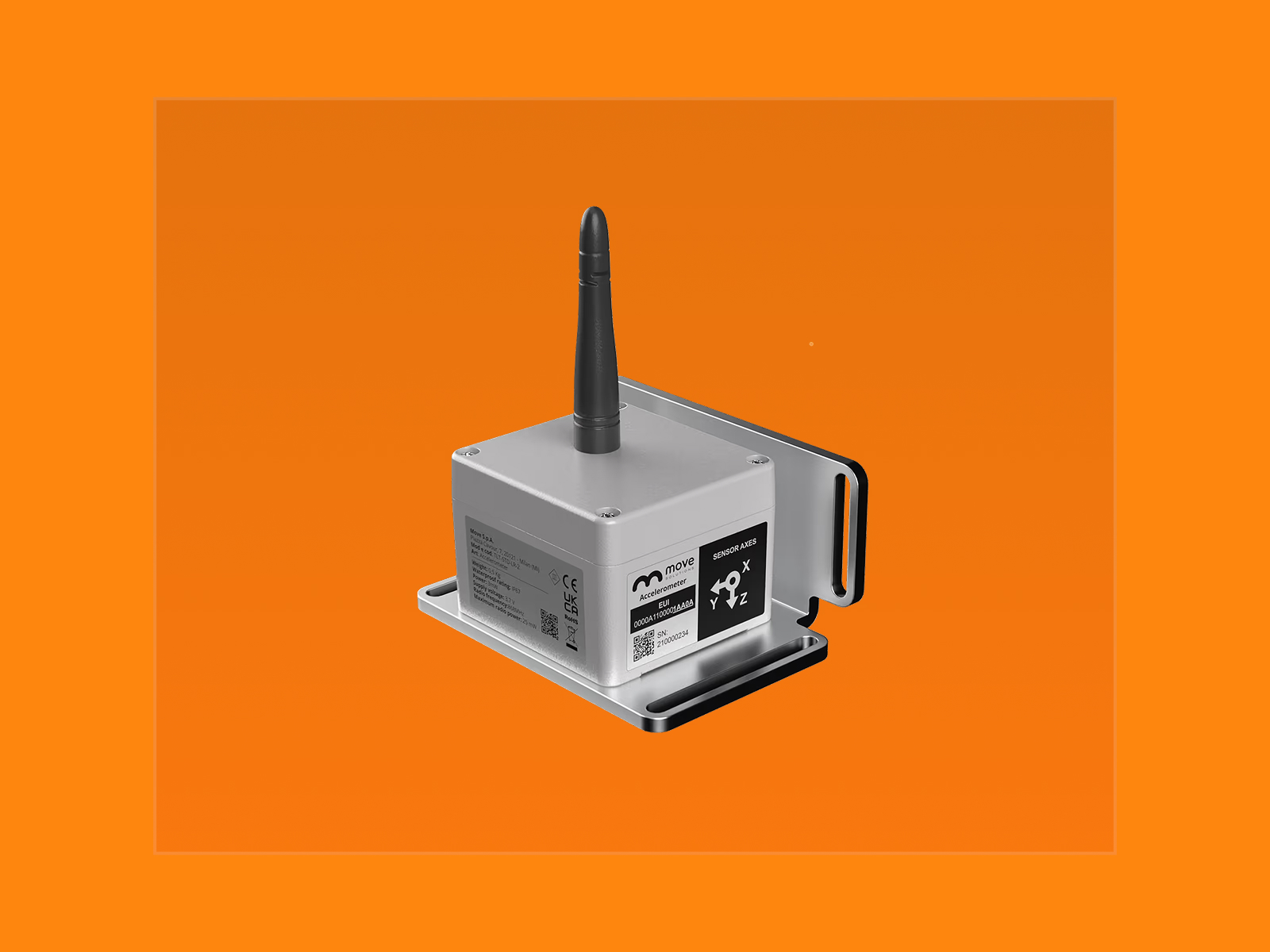
The DECKAXE-SHM is our triaxial wireless accelerometer, built for modal analysis on bridges and large structures, with selectable sampling from 40 to 640 Hz and native compatibility with the Modal Analysis Tool in MyMove, which computes modal frequencies, mode shapes and damping from the network's data. The sensor and the processing are designed as one pipeline, not bolted together afterward.
A typical first deployment on a medium-span bridge is four to eight triaxial accelerometers at deck mid-span and the quarter-spans, plus one tiltmeter per pier to catch the slow rotational story the accelerometer cannot. You can always densify later once the asset owner trusts the data.
Wireless systems can be deployed quicker and on a much smaller budget, since a cabled accelerometer network on an existing viaduct buries the sensor cost under weeks of civil works, and in the large majority of retrofits cabling is simply uneconomic. A wireless MEMS node bonded or bolted to the deck, communicating over LoRaWAN to a single gateway, reduces this timeline and lets a two-person crew instrument a span in a day. There is regulatory pull behind this too. Italy's CSLP / MIT 2020 bridge guidelines define a dynamic monitoring requirement for higher Class-of-Attention bridges, with a compliance horizon that has owners across the country specifying permanent accelerometer networks rather than one-off campaigns.
One honest limit. Continuous accelerometer monitoring is not always justified. If a structure has no regulatory obligation, no active deterioration, no nearby works that could induce vibration, and a visual-inspection regime that is genuinely being followed, we will tell you to skip it. Sensors catch slow modal drift and transient overloads. Inspectors catch hidden corrosion and human-error damage. Both are needed, and a network is not a substitute for someone competent walking the structure.
Frequently Asked Questions
Is MEMS good enough, or do I still need piezoelectric for a bridge?
For permanent ambient-vibration modal monitoring on civil structures, a modern low-noise MEMS node is a good choice, and field comparisons put it within a fraction of a percent of IEPE piezoelectric references on identified frequencies. Piezoelectric still wins for high-frequency, low-amplitude work and laboratory characterisation, but its AC coupling and cabling make it the wrong fit for a wireless permanent deployment.
Can one accelerometer network replace visual inspection?
No. A network catches slow modal drift and transient overloads that an inspector cannot feel, while an inspector catches hidden corrosion, section loss and damage from human error that a modal frequency will not reveal. Regulatory frameworks are increasingly codifying that both are required.
Why does a dropping natural frequency mean damage?
Because natural frequency is a function of stiffness and mass, and structural damage almost always shows up as a loss of stiffness. Cracking, corrosion, a seized bearing or fatigue all reduce stiffness, which lowers the natural frequencies and distorts the mode shapes near the affected region. A few-percent drift tracked over time is a far earlier warning than waiting for a crack wide enough to see.
Can a MEMS accelerometer measure static tilt, or do I need a separate tiltmeter?
A DC-capable MEMS accelerometer technically senses the gravity vector, but its resolution at near-zero frequency is far too coarse to track the sub-millidegree rotations that matter on a leaning pier. For slow tilt and settlement you want a dedicated tiltmeter. The accelerometer is for dynamics, the tiltmeter is for the slow rotational story, and a real campaign runs both.
What single datasheet number should I check first?
Noise density in µg/√Hz, read in the frequency band your structure actually occupies. Civil modes are low-frequency and low-amplitude, so the noise floor, not the full-scale range or a wide advertised bandwidth, decides whether the sensor will see the signal at all. A datasheet that quotes noise only at high frequency is quoting the number that flatters it.
Other articles



Subscribe to Updates
Stay informed about our latest innovations and insights.