MEMS, electrolytic or force-balance: which tiltmeter to choose for structural monitoring
Join the Move Solutions newsletter
Stay updated on product releases, news, and upcoming webinars.
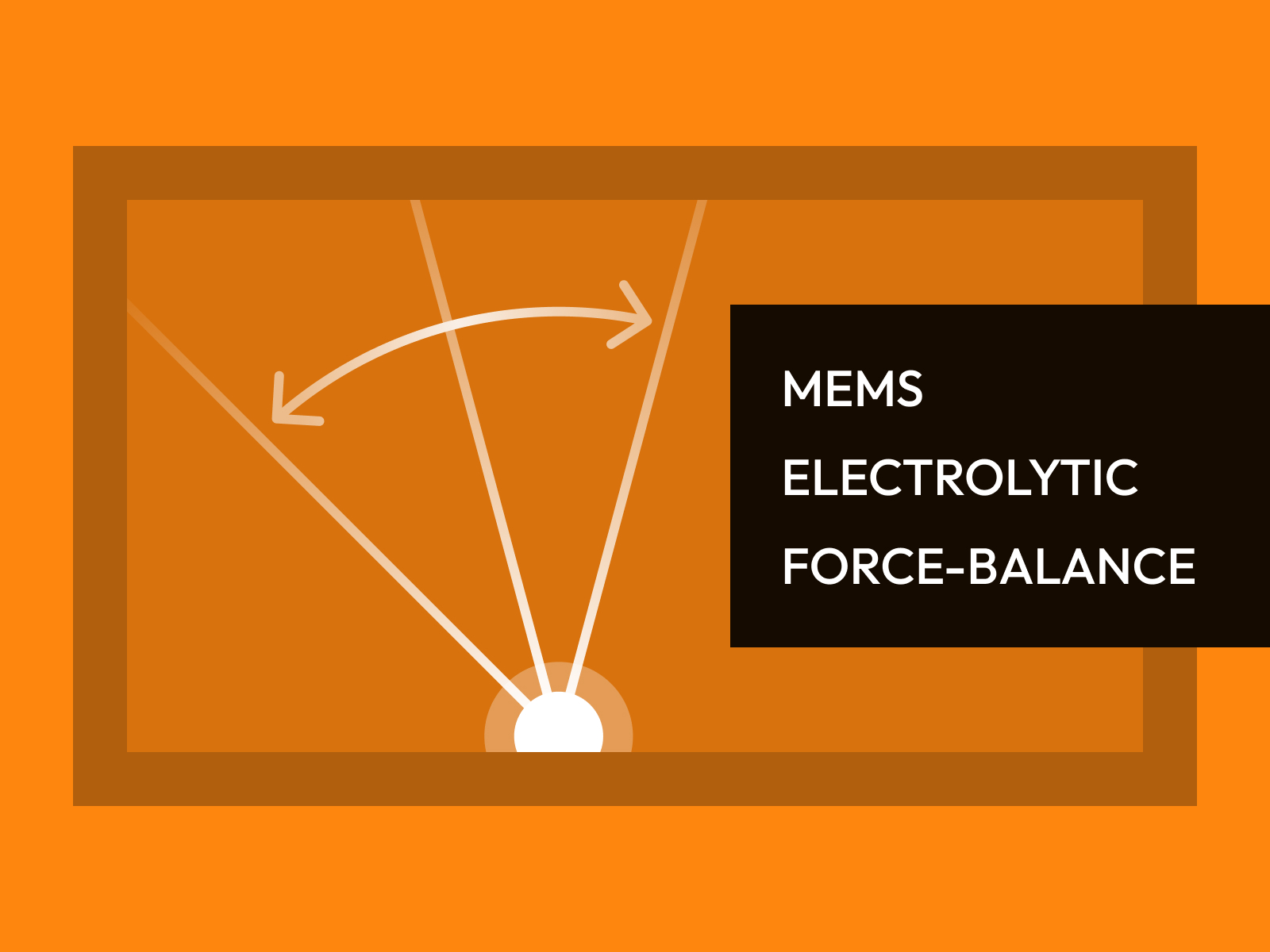
The different types of tiltmeters have clear differences in resolution, but on the job site it can be unclear which instrument to use. A commercial MEMS tiltmeter resolves 0.01°. A high-end electrolytic sensor reaches 0.0001°. A geophysical force-balance goes down to 1 nrad — five orders of magnitude below the MEMS. So what does the choice depend on?
The finest resolution is not always the top priority, and the first question to ask is which technology matches the structure being observed and the conditions the sensor will face.
The three families to compare
Four sensing principles are in commercial use for tiltmeter, but three dominate the structural and geotechnical market: MEMS, electrolytic and force-balance. The fourth, vibrating-wire, is used in geotechnical niches where passive electrical operation is needed, but is being progressively replaced by MEMS. The comparison for civil monitoring stays on the three dominant technologies.
MEMS: the silicon seismic-mass family
A MEMS tiltmeter uses a silicon micro-structure — a small mass suspended by micro-machined springs — whose displacement under gravity is read capacitively. The output is proportional to the gravitational component projected onto the measurement axis. Since gravity is the only static acceleration, a MEMS accelerometer works as an tiltmeter for slow measurements.
The typical resolution of a MEMS sensor ranges from 0.001° to 0.01° depending on the model. The residual thermal drift, after factory compensation, is typically between 10 and 50 µrad/°C for commercial units.
An important advantage of these sensors is their battery life. Power consumption is in the microwatt range during sleep, so they allow wireless installations with multi-year battery autonomy. They also have very high vibration and shock tolerance, and the sensor survives accelerations well beyond its measurement range.
MEMS is recommended for structures subject to vibration (bridges under traffic, buildings with mechanical systems, machinery foundations), but also where wireless is needed, and where the phenomenon is comfortably above the noise floor. It should not be used in geophysical applications requiring sub-microradian resolution or in very slow measurements over multi-year windows, where it struggles to distinguish sensor drift from the actual phenomenon.
Electrolytic: the conductive-fluid family
An electrolytic sensor is a sealed cavity made of glass or ceramic, partially filled with a conductive electrolyte and fitted with multiple electrodes. When the sensor tilts, the liquid redistributes and the impedance between electrode pairs changes. The reading is differential, typically in AC.
Its resolution reaches 0.0001° in high-end models. Low-frequency noise is extremely low, because the fluid mechanically integrates the high frequencies.
The problematic aspect of this technology is the temperature coefficients, which typically range from 0.01 to 0.1% per °C of full scale. They vary with the electrolyte composition and require individual compensation for precision applications.
Maintenance is worse than for MEMS sensors, because the fluid reacts unpredictably and shocks damage the seals. In addition, the continuous AC excitation required for the reading drains the device battery faster than other types.
The electrolytic is very useful for static or very slow measurements on rigid structures and in stable environments such as dam foundations and laboratory structural tests. These are long-term monitoring applications where the noise floor becomes critical for correct analysis, and therefore the drawbacks are tolerable.
Force-balance: the nanoradian family
A force-balance tiltmeter holds a pendulum at its null position with a feedback loop, where a coil applies the current needed to balance the mass, and that current is proportional to the tilt. The principle is that the servo-control loop bypasses the mechanical limits of the free pendulum.
The resolution of this technology reaches below the microradian, down to 1 nrad in precision geophysical instruments, with well-characterised linearity and low noise at all frequencies.
In return, power consumption is high because the feedback loop is always active, and the cost is 10–50 times that of a comparable MEMS.
The force-balance wins where the signal is at the nanoradian level — tectonic monitoring, volcano deformation and scientific instrumentation. On a deteriorating bridge it is the wrong instrument, because its resolution is orders of magnitude beyond what the structural phenomenon requires.
How to choose?
The technology choice for structural monitoring is fairly straightforward.
- If the structure vibrates (bridges under traffic, buildings with HVAC, machinery foundations), the most suitable choice is MEMS. The electrolytic would return unreliable readings and the force-balance would be an expensive overkill.
- If the phenomenon is slow creep on a rigid structure (dam abutment, bridge foundation on rock, laboratory specimen), the electrolytic or the MEMS is the better fit. More precisely: the electrolytic if the noise floor is the constraint, and the MEMS if wireless and autonomy are needed.
- If the phenomenon is tectonic or geophysical (volcanoes, faults, bedrock deformation), a force-balance should be used, since nothing else has adequate resolution.
- If the deployment is wireless with multi-year battery autonomy, the best choice is MEMS, because the other technologies consume too much energy to run for years without recharging.
- If the structure is a heritage asset with reversibility constraints, the best option is MEMS, thanks to its compact form factor and low power consumption, which allow adhesive mounting or minimal fixings.
Most structural projects fall into cases 1, 4 and 5. MEMS dominates the civil market because the distribution of real-world problems matches its operating envelope.
The objection about MEMS longevity
A recurring technical objection is that MEMS has moving parts, so it wears out before an electrolytic. At a physical level the observation is legitimate. The silicon structure has stressed elements and failure modes that the electrolytic sensor does not: stiction, spring fracture, wafer degradation.
In practice, however, field data from 5–10-year MEMS deployments on bridges and buildings show mean times to failure comparable to or greater than those of electrolytic sensors in the same environment. The reason is that electrolytic sensors also have their own failure modes, equally important for data integrity: fluid evaporation, seal degradation or electrode corrosion.
MEMS does not last forever, but over realistic deployment horizons it is not materially worse and offers important advantages.
Other articles





Subscribe to Updates
Stay informed about our latest innovations and insights.