Bridge Scour During Floods and the Limits of Inspections
Join the Move Solutions newsletter
Stay updated on product releases, news, and upcoming webinars.
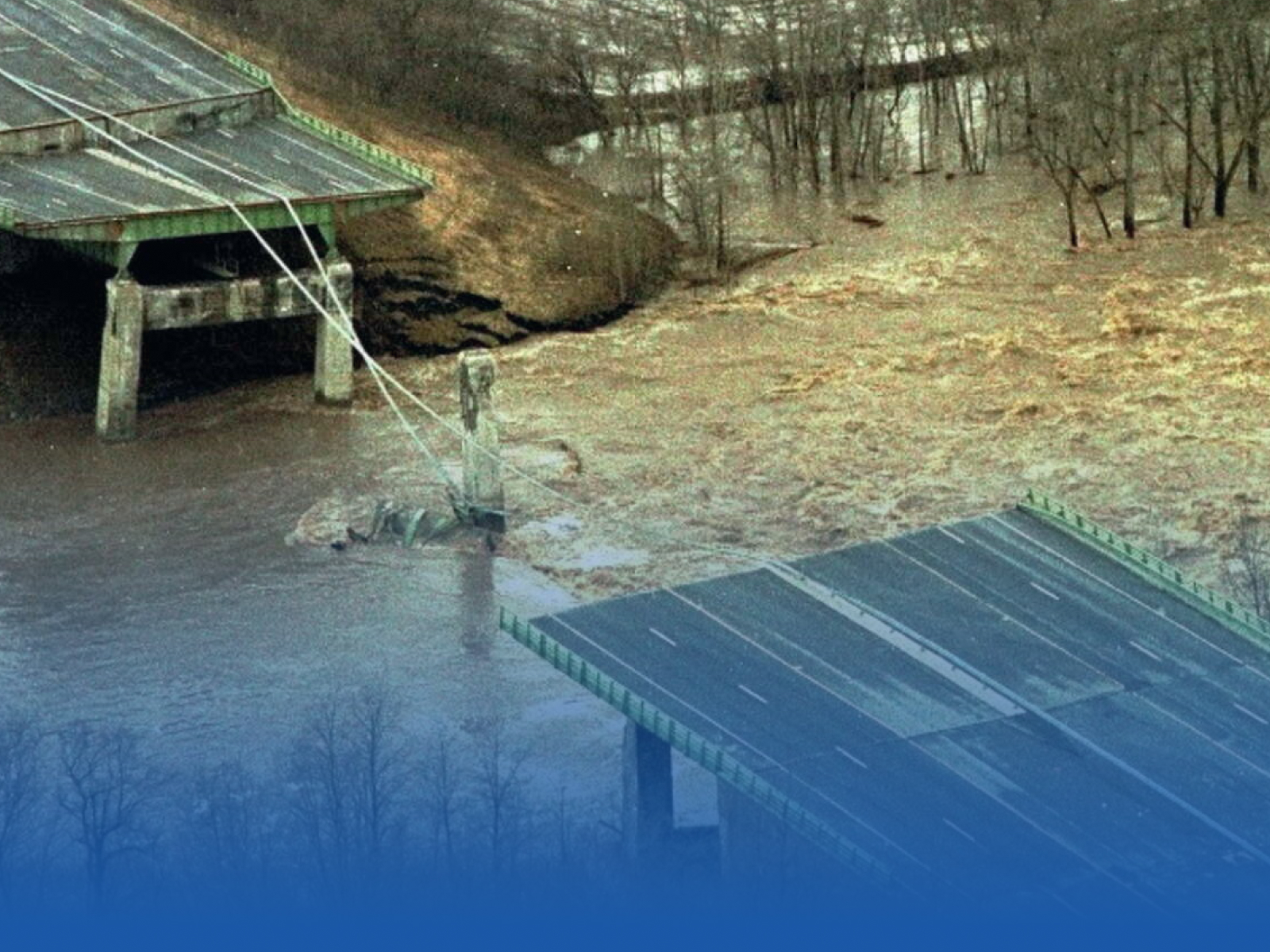
On April 5, 1987, during a spring flood on Schoharie Creek, scour undermined pier 3 of the New York State Thruway bridge and two spans fell into the river, followed ninety minutes later by pier 2 and a third span. Ten people died. In the years before, the backfill around pier 3 had gradually eroded and had been replaced by river deposits, so the footing was losing protection while the streambed looked unchanged. As a consequence, in 1988 FHWA required every bridge over water to be evaluated for scour.
Scour is still the leading cause of bridge failure in the US. Wardhana and Hadipriono studied more than 500 failures between 1989 and 2000 and attributed almost 53% of them to floods and scour. Yet bridge scour monitoring still relies mostly on the underwater inspection and on the visit after the flood, and neither takes place while the river is at its peak.
Scour after the flood
It is well known among hydraulic engineers that scour holes refill. During the flood the water removes material around a pier, and as the flow slows down it deposits sediment back into the hole. So the streambed that an inspector measures after the flood is not the streambed that supported the pier at the peak.
Between 1996 and 1998 the USGS used ground-penetrating radar at New Hampshire bridges before and after floods, and found infilled scour holes in seven cross sections, with infill from less than 1 foot up to 4 feet. The authors noted that a steel rod and a hammer, still common tools after floods, could hardly detect the infill on cobble beds or in deep water.
A refilled hole does not mean that the foundation has recovered its support, but that the evidence of the lost support has been covered. Loose infill does not carry load like the original bed, and it gets removed with the next flood. Routine underwater inspections are no closer to the event, since under the NBIS divers inspect underwater elements at intervals of up to 60 months.
Scour critical bridges and plans of action
Under the NBIS, owners have to identify scour critical bridges, coded 0 to 3 in NBI Item 113 (U for unknown foundations, which usually follow the same process), and prepare a plan of action for each of them. In many states the trigger in the plan is a National Weather Service flood warning or a river stage at a nearby gauge, after which inspectors visit the bridge, look for debris, settlement and visible movement, and close it if the conditions in the plan are met.
This works for bridges already known to be at risk, but hydraulic collapses also happen elsewhere. A retrospective analysis published in the ASCE Journal of Performance of Constructed Facilities examined 239 hydraulic collapses, 55% of all the collapses in its dataset. Among the collapsed bridges with a scour evaluation, only 17% had been coded scour critical before the collapse, and 83% had been rated scour stable. The authors also found that the substructure condition rating was a better indicator of collapse than the scour critical rating.
So the scour critical list is a calculated vulnerability, based on hydraulic models and foundation assumptions. During a flood, the decision to keep a bridge open depends on a river level and on what an inspector can see from the bank, which is very little of a submerged footing.
Structural response during a flood
Thankfully, the effects of scour can be measured because as it removes support from a foundation, the pier moves. On a spread footing like the one at Schoharie Creek, the loss of support appears as settlement and rotation of the pier, often toward the upstream nose, where local scour is deepest. A tiltmeter on the pier cap measures that rotation continuously from above the water, with sub-milliradian resolution.
Piers also rotate for other reasons, because temperature changes the length of the deck and moves the bearings, so every pier has a daily and seasonal rotation band. To separate the two, engineers read the tilt against the river stage. Thermal rotation follows the temperature cycle and comes back, while rotation from loss of support appears as a step during high water and does not recover when the water drops. River stage from a USGS gauge or from a water level sensor already on site can be brought into MyMove through third-party sensor integration, so engineers can compare the two series on the same timeline.
Vibration is another channel for monitoring, as scour reduces the stiffness of the soil around a foundation, so the natural frequencies of the pier decrease, and accelerometers with the Modal Analysis Tool can track them from ambient traffic. The effect is clear in laboratory and numerical studies, less so in the field. On a bridge monitored during a repair that raised the riverbed, the model predicted a 3 to 5% change in the first two frequencies, but the frequencies measured on site varied widely, also because water level and temperature change frequencies. A frequency shift during a flood is weak evidence on its own.
With structural data, the owner can add to the plan of action a second trigger based on the bridge itself, a tilt threshold set from the rotation band recorded before the flood, with alarms sent to the team responsible for closures. After the flood, inspectors can see from the residual rotation of each pier which foundation lost support, and divers can start from that pier.
Frequently Asked Questions
Can sensors on the bridge measure scour depth?
No. Tiltmeters and accelerometers measure the response of the structure, while scour depth needs sonar, scour probes or divers. Pier rotation appears only when the foundation is already losing support, so engineers can use it as a closure trigger and as a guide for the post-flood inspection, not as a forecast.
Which scour critical bridges should be instrumented first?
Bridges on spread footings over erodible beds, and bridges with unknown foundations. On these, a loss of support quickly becomes pier rotation, while pile foundations have more reserve and rotate only closer to failure.
Does continuous data replace the post-flood underwater inspection?
No. Engineers learn from the data which piers moved and by how much, and divers confirm the scour depth and the condition of the footing during the underwater inspection.
Other articles





Subscribe to Updates
Stay informed about our latest innovations and insights.