Why did the Carola Bridge Collapse in Dresden? The Limits of Visual Bridge Inspection on Post-Tensioned Concrete
Join the Move Solutions newsletter
Stay updated on product releases, news, and upcoming webinars.
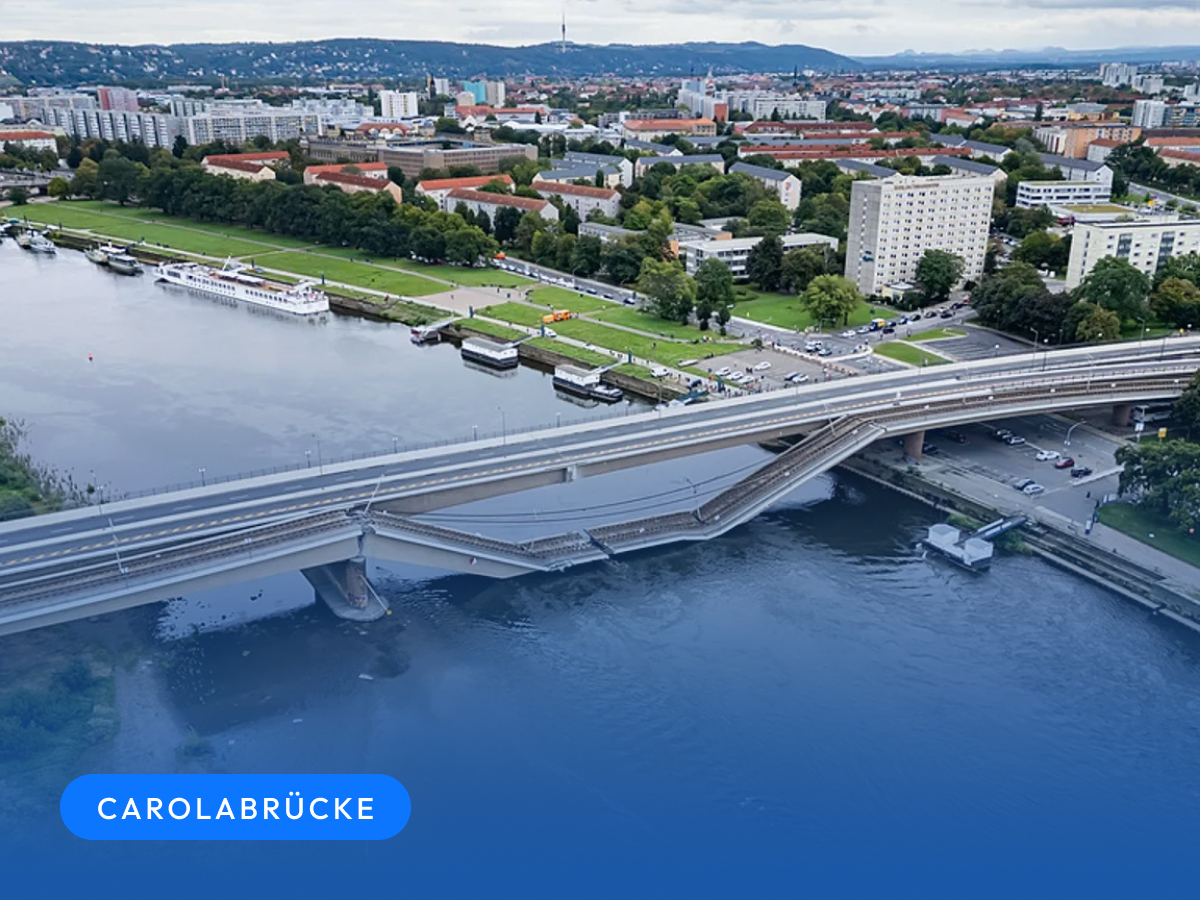
In the early hours of 11 September 2024, a tram crossed the Carola Bridge in Dresden, Germany. 18 minutes later, the bridge collapsed and dropped into the Elbe river below it. The bridge had been inspected correctly and on schedule, had been through repeated structural recalculations between 2018 and 2023, and carried instrumentation on a known deformation at one of its hinges. So why did the bridge collapse and why was there no warning before it happened?
The visual inspections
A visual inspection looks at the concrete on the exterior of a structure to see if there are any cracks that could indicate specific damage to the load-bearing structures inside. If the load starts to deform the structure, the concrete cracks in a specific manner.
But the Carola Bridge had no such signs. It was completed in 1971 using prestressing strands. Those are usually inside metal or plastic ducts, and the ducts sit inside the section, filled with grout that is supposed to seal them. However, the very same ducts that protect the strands from corrosion also hide them, which is why degradation of post-tensioned cables is not fully detectable through conventional investigation methods or visual inspection.
Damage to embedded tendons initiates and propagates out of sight, and local corrosion does not generally change the external appearance of the bridge until it is too late. Reaching the steel means invasive access, typically drilling and a borescope.
In case of the Carola Bridge, later investigations revealed more than 68 percent of the tendons in the deck slab of span C were severely damaged at the fracture section, and none of that was establishable within the legally prescribed inspections.
Chloride-induced corrosion of ordinary reinforcement does announce itself, through rust staining, spalling and delamination that an inspector with a hammer can find. However, stress corrosion cracking of high-strength prestressing steel behaves differently. It produces brittle rupture with no ductile deformation and no widening crack pattern on the soffit, so nothing on the surface exposes how much section has already been lost.
The mechanism of the collapse
Dresden inspected the bridge regularly under the applicable standards, implemented the federal recommendations on prestressed concrete bridges, and answered specific risks with special investigations and continuous surveillance. The investigation team led by Steffen Marx concluded that reliable prediction of the collapse was not possible with the usual methods, and found no negligence by those responsible.
The mechanism was hydrogen-induced stress corrosion cracking, caused by moisture entering during the construction phase and compounded by fatigue of the prestressing steel under traffic. The damage was contemporary with the bridge, completed in 1971 using Hennigsdorfer prestressing steel. Corrosion then progressed for decades inside the structure, invisible from outside and largely independent of surface damage patterns. Stress corrosion cracking in prestressing steel was unknown when the bridge was built.
The final trigger for the collapse was a single overnight temperature drop. After a warm period, this thermal change generated additional stresses, because the interior of the section cooled more slowly than the outer parts.
Cracks before failure
A post-tensioned deck is not supposed to fail quietly. As tendons break, the compression they applied disappears, the concrete goes into tension, and the section cracks. Those cracks are meant to open well before the deck runs out of capacity, so an inspector walking underneath sees the problem while there is still reserve left. Engineers verify this on paper by removing tendons from the model one group at a time and checking that cracking arrives before collapse, and a bridge that passes is treated as safe to keep in service under periodic inspection.
The Carola Bridge passed that check. It then collapsed with no crack pattern that anyone had reported. MKP is now running a research project on exactly that mismatch, looking for what the codes get wrong rather than treating Dresden as one unlucky structure.
The gap is between what the calculation promises and what it promises about. It says cracks will appear in the modelled cross-section. It does not say where along 100 metres of deck, how many months before failure, or whether the crack opens on a face someone can see from the ground. A warning that appears inside a box girder, or three weeks after the last principal inspection, has no reader.
Detection methods against this failure mode
No sensor can read the residual capacity of a bridge, it needs to be recalculated by engineers. These calculations take into consideration how much prestressing steel is still intact.
On span C that figure came from the drawings. The recalculations run between 2018 and 2023 used the design tendon area, while at the fracture section more than two thirds of the tendons were already damaged. The methods below differ mainly in whether they would have replaced the design figure with a measured one.
Deflection and levelling
This method was used on the Carola Bridge and, unfortunately, it did not help. A hinge deformation dating from the early life of the bridge was known, studied in depth, and kept under close measurement. No critical increase appeared in the years before the collapse.
A bridge deck can lose a large fraction of its tendons without the deflection curve moving enough to trip a threshold, because broken tendons re-anchor in the surrounding grout and the prestress redistributes locally.
Acoustic emission
AE listens for the elastic wave released when a wire breaks, and with enough sensors the break can be located. It is the only technique that would have counted the losses as they happened, and the proof came from the same structure.
On 18 February 2025, after a temperature drop comparable to the one that preceded the collapse and frost down to nearly minus 11 degrees, sensors on the surviving spans A and B registered further tendon fractures near pier D, and river traffic underneath was prohibited again.
Of course, acoustic emission reports what breaks after installation and says nothing about what broke in the previous fifty years. Therefore, a system switched on in 2010 would have shown a rate of capacity loss, not a total from the beginning of the bridge's operation. On a structure corroding since construction, a rate is still enough to force a recalculation of the capacity.
Remanent magnetism and magnetic flux leakage
Both methods read the magnetic signature of the steel through the cover to find wire breaks and section loss, and both produce the total rather than the rate. Marx named acoustic emission and remanent magnetism as the two techniques that bridges of this construction type will have to be examined with in future, which is a direct statement that the standard inspection catalogue was not equipped for this failure mode.
An FHWA study reached a compatible conclusion on the magnetic flux leakage side, calling it potentially field-deployable while noting it was still early in development. Access geometry stays the practical constraint on a box girder over a river.
Endoscopy and material sampling
Drilling into the duct and inspecting with a borescope gives conclusive evidence of grout condition and strand surface at the point sampled. On the Carola Bridge the governing damage was found in the large cantilever above pier D, in one region of a structure over 100 metres long. A sampling campaign finds that concentration if it drills there, which is a question of where the samples were placed rather than how many were taken.
Ground-penetrating radar
GPR locates the duct layout, which is the precondition for aiming any of the other methods, particularly on bridges whose as-built drawings disagree with what was poured. It maps where corrosion has an opportunity rather than measuring corrosion.
Vibration-based monitoring
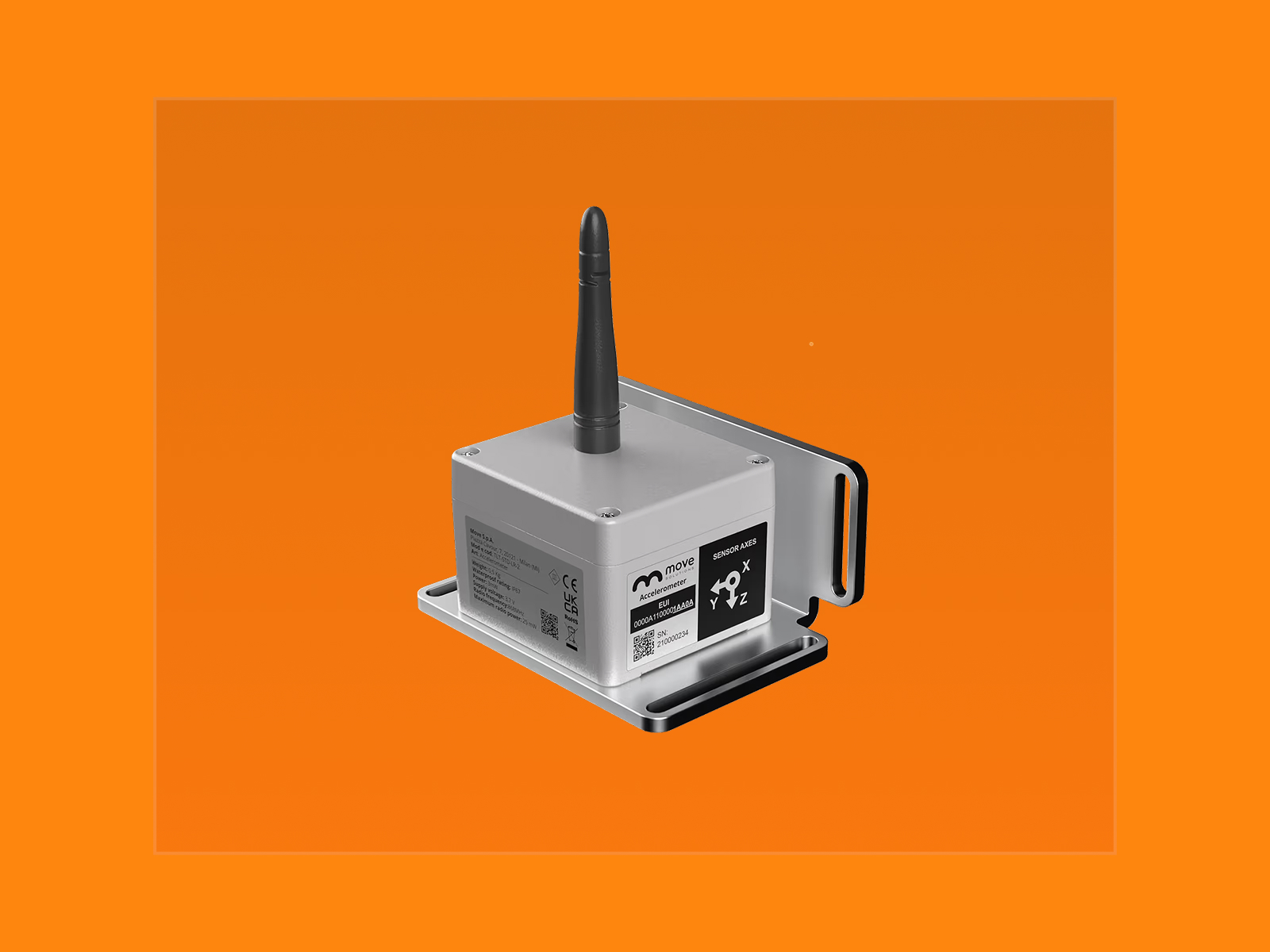
Accelerometers measure how the deck responds to traffic and wind, and operational modal analysis extracts frequencies, mode shapes and damping without controlled excitation. The method is global, so a triaxial accelerometer does not need to sit on the damaged element to register a stiffness change.
Applied to Carola Bridge, it faces the same physics as the levelling. Prestress loss reduces stiffness, but the re-anchoring effect and the redundancy of a multi-cell box mean the modal signature moves late and moves little. A years-long baseline with temperature compensation would plausibly have shown a downward drift in the first bending frequency. That drift is not a tendon count, so on its own it would not have replaced the design figure or forced a recalculation of capacity.
Instrumenting a bridge with suspect prestressing steel
The German response after the bridge collapse in Dresden prioritized the most important elements of monitoring. Nineteen bridges were identified in Saxony alone for deeper investigation, and where the authorities kept a structure open they put acoustic emission on it, in one case combined with a lane restriction and traffic lights while a replacement is planned. Acoustic emission goes first because it is the only channel that helps directly with the recalculation of capacity.
A tiltmeter per pier and accelerometers at mid-span and quarter-spans give the global behaviour that tells an engineer whether a run of wire breaks has changed anything the structure does, which is what turns a count of events into a decision about traffic.
Environmental measurement would have also been very important in this case. Seasonal thermal swings move modal frequencies by 2 to 10 percent on a typical concrete bridge, which is wider than the damage signature being looked for, and at Dresden the temperature drop was the trigger of the collapse. An environmental sensor in the same network as the accelerometers keeps both streams on one timebase inside MyMove.
Continuous monitoring complements visual inspection and does not replace it. Sensors track slow drift in structural response and catch transient overloads, while inspectors find corrosion at close range, impact damage, drainage failures and the consequences of previous repairs. Both are required, and regulators have started writing that requirement into the codes.
Frequently Asked Questions
Would continuous monitoring have prevented the Carola Bridge collapse?
Acoustic emission would have counted the fractures as they accumulated and forced a recalculation, which is what it did on the surviving spans in February 2025. Neither AE nor a vibration network detects stress corrosion cracking itself, and neither returns a capacity figure without a structural recalculation behind it.
Can visual inspection detect tendon corrosion at all?
Only its late consequences, such as longitudinal cracking along the duct line, rust staining at anchorages, or measurable deflection change. By the time those appear, section loss is advanced. Italian and American guidance both require special investigations for post-tensioned structures instead of treating them as ordinary reinforced concrete.
Does a monitoring system reduce the required inspection frequency?
No, under the frameworks currently in force. Instrumental monitoring sits on top of the surveillance regime for structures above a risk threshold, and no code allows sensor data to substitute for a principal inspection. Some administrations do use monitoring data to justify keeping a structure in service under restrictions while replacement is planned.
Other articles



Subscribe to Updates
Stay informed about our latest innovations and insights.